1
JEE Main 2021 (Online) 27th August Evening Shift
Numerical
+4
-1

Two flasks I and II shown below are connected by a valve of negligible volume.
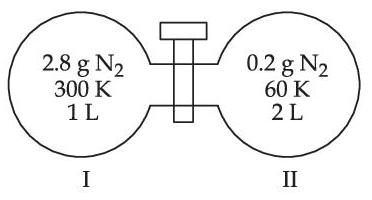
When the valve is opened, the final pressure of the system in bar is x $$\times$$ 10$$-$$2. The value of x is __________. (Integer answer)
[Assume - Ideal gas; 1 bar = 105 Pa; Molar mass of N2 = 28.0 g mol$$-$$1; R = 8.31 J mol$$-$$1 K$$-$$1]
When the valve is opened, the final pressure of the system in bar is x $$\times$$ 10$$-$$2. The value of x is __________. (Integer answer)
[Assume - Ideal gas; 1 bar = 105 Pa; Molar mass of N2 = 28.0 g mol$$-$$1; R = 8.31 J mol$$-$$1 K$$-$$1]
Your input ____
2
JEE Main 2021 (Online) 27th August Evening Shift
Numerical
+4
-1
Data given for the following reaction is as follows :
FeO(s) + C(graphite) $$\to$$ Fe(s) + CO(g)
The minimum temperature in K at which the reaction becomes spontaneous is ___________. (Integer answer)
FeO(s) + C(graphite) $$\to$$ Fe(s) + CO(g)
| Substance | $$\Delta H^\circ $$ (kJ mol$$^{ - 1}$$) |
$$\Delta S^\circ $$ (J mol$$^{ - 1}$$ K$$^{ - 1}$$) |
|---|---|---|
| $$Fe{O_{(s)}}$$ | $$ - 266.3$$ | 57.49 |
| $${C_{(graphite)}}$$ | 0 | 5.74 |
| $$F{e_{(s)}}$$ | 0 | 27.28 |
| $$C{O_{(g)}}$$ | $$ - 110.5$$ | 197.6 |
The minimum temperature in K at which the reaction becomes spontaneous is ___________. (Integer answer)
Your input ____
3
JEE Main 2021 (Online) 27th August Morning Shift
Numerical
+4
-1
200 mL of 0.2 M HCl is mixed with 300 mL of 0.1 M NaOH. The molar heat of neutralization of this reaction is $$-$$57.1 kJ. The increase in temperature in $$^\circ$$C of the system on mixing is x $$\times$$ 10$$-$$2. The value of x is ___________. (Nearest integer)
[Given : Specific heat of water = 4.18 J g$$-$$1 K$$-$$1, Density of water = 1.00 g cm$$-$$3]
[Assume no volume change on mixing)
[Given : Specific heat of water = 4.18 J g$$-$$1 K$$-$$1, Density of water = 1.00 g cm$$-$$3]
[Assume no volume change on mixing)
Your input ____
4
JEE Main 2021 (Online) 26th August Evening Shift
Numerical
+4
-1
For water $$\Delta$$vap H = 41 kJ mol$$-$$1 at 373 K and 1 bar pressure. Assuming that water vapour is an ideal gas that occupies a much larger volume than liquid water, the internal energy change during evaporation of water is ___________ kJ mol$$-$$1
[Use : R = 8.3 J mol$$-$$1 K$$-$$1]
[Use : R = 8.3 J mol$$-$$1 K$$-$$1]
Your input ____
JEE Main Subjects
Browse all chapters by subject
Physics
Mechanics
Units & Measurements Vector Algebra Motion in a Straight Line Motion in a Plane Circular Motion Laws of Motion Work Power & Energy Center of Mass and Collision Rotational Motion Properties of Matter Heat and Thermodynamics Simple Harmonic Motion Waves Gravitation
Electricity
Electrostatics Current Electricity Capacitor Magnetic Effect of Current Magnetic Properties of Matter Electromagnetic Induction Alternating Current Electromagnetic Waves
Optics
Modern Physics
Chemistry
Physical Chemistry
Some Basic Concepts of Chemistry Structure of Atom Redox Reactions Gaseous State Chemical Equilibrium Ionic Equilibrium Solutions Thermodynamics Electrochemistry Chemical Kinetics and Nuclear Chemistry Solid State Surface Chemistry
Inorganic Chemistry
Periodic Table & Periodicity Chemical Bonding & Molecular Structure Isolation of Elements Hydrogen s-Block Elements p-Block Elements d and f Block Elements Coordination Compounds Salt Analysis Environmental Chemistry
Organic Chemistry
Mathematics
Algebra
Sets and Relations Logarithm Quadratic Equation and Inequalities Sequences and Series Mathematical Induction Binomial Theorem Matrices and Determinants Permutations and Combinations Probability Vector Algebra 3D Geometry Complex Numbers Statistics Mathematical Reasoning
Trigonometry
Trigonometric Ratio and Identites Trigonometric Equations Inverse Trigonometric Functions Properties of Triangle Height and Distance
Coordinate Geometry
Calculus