1
JEE Main 2020 (Online) 5th September Evening Slot
MCQ (Single Correct Answer)
+4
-1

Two coherent sources of sound, S1 and S2,
produce sound waves of the same wavelength,
$$\lambda $$ = 1 m, in phase. S1 and S2 are placed 1.5 m
apart (see fig). A listener, located at L, directly
in front of S2 finds that the intensity is at a
minimum
when he is 2 m away from S2. The listener moves away from S1, keeping his distance from S2 fixed. The adjacent maximum of intensity is observed when the listener is at a distance d from S1. Then, d is :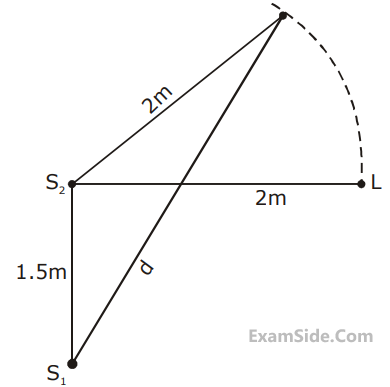
when he is 2 m away from S2. The listener moves away from S1, keeping his distance from S2 fixed. The adjacent maximum of intensity is observed when the listener is at a distance d from S1. Then, d is :
2
JEE Main 2020 (Online) 4th September Morning Slot
MCQ (Single Correct Answer)
+4
-1
A beam of plane polarised light of large
cross-sectional area and uniform intensity
of 3.3 Wm-2 falls normally on a
polariser (cross sectional area 3 $$ \times $$ 10-4 m2) which
rotates about its axis with an angular speed
of 31.4 rad/s. The energy of light passing through
the polariser per revolution, is close to :
cross-sectional area and uniform intensity
of 3.3 Wm-2 falls normally on a
polariser (cross sectional area 3 $$ \times $$ 10-4 m2) which
rotates about its axis with an angular speed
of 31.4 rad/s. The energy of light passing through
the polariser per revolution, is close to :
3
JEE Main 2020 (Online) 3rd September Evening Slot
MCQ (Single Correct Answer)
+4
-1
Two light waves having the same wavelength $$\lambda $$ in vacuum are in phase initially. Then the first wave
travels a path L1
through a medium of refractive index n1
while the second wave travels a path of length
L2
through a medium of refractive index n2
. After this the phase difference between the two waves is :
4
JEE Main 2020 (Online) 3rd September Morning Slot
MCQ (Single Correct Answer)
+4
-1
In a Young’s double slit experiment, light of
500 nm is used to produce an interference
pattern. When the distance between the slits
is 0.05 mm, the angular width (in degree) of
the fringes formed on the distance screen is
close to
JEE Main Subjects
Browse all chapters by subject
Physics
Mechanics
Units & Measurements Vector Algebra Motion in a Straight Line Motion in a Plane Circular Motion Laws of Motion Work Power & Energy Center of Mass and Collision Rotational Motion Properties of Matter Heat and Thermodynamics Simple Harmonic Motion Waves Gravitation
Electricity
Electrostatics Current Electricity Capacitor Magnetic Effect of Current Magnetic Properties of Matter Electromagnetic Induction Alternating Current Electromagnetic Waves
Optics
Modern Physics
Chemistry
Physical Chemistry
Some Basic Concepts of Chemistry Structure of Atom Redox Reactions Gaseous State Chemical Equilibrium Ionic Equilibrium Solutions Thermodynamics Electrochemistry Chemical Kinetics and Nuclear Chemistry Solid State Surface Chemistry
Inorganic Chemistry
Periodic Table & Periodicity Chemical Bonding & Molecular Structure Isolation of Elements Hydrogen s-Block Elements p-Block Elements d and f Block Elements Coordination Compounds Salt Analysis Environmental Chemistry
Organic Chemistry
Mathematics
Algebra
Sets and Relations Logarithm Quadratic Equation and Inequalities Sequences and Series Mathematical Induction Binomial Theorem Matrices and Determinants Permutations and Combinations Probability Vector Algebra 3D Geometry Complex Numbers Statistics Mathematical Reasoning
Trigonometry
Trigonometric Ratio and Identites Trigonometric Equations Inverse Trigonometric Functions Properties of Triangle Height and Distance
Coordinate Geometry
Calculus