1
JEE Main 2021 (Online) 16th March Morning Shift
MCQ (Single Correct Answer)
+4
-1

The angle of deviation through a prism is minimum when
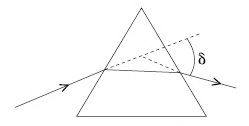
(A) Incident ray and emergent ray are symmetric to the prism.
(B) The refracted ray inside the prism becomes parallel to its base
(C) Angle of incidence is equal to that of the angle of emergence
(D) When angle of emergence is double the angle of incidence
Choose the correct answer from the options given below :
(A) Incident ray and emergent ray are symmetric to the prism.
(B) The refracted ray inside the prism becomes parallel to its base
(C) Angle of incidence is equal to that of the angle of emergence
(D) When angle of emergence is double the angle of incidence
Choose the correct answer from the options given below :
2
JEE Main 2021 (Online) 26th February Evening Shift
MCQ (Single Correct Answer)
+4
-1
The incident ray, reflected ray and the outward drawn normal are denoted by the unit vectors $$\overrightarrow a $$, $$\overrightarrow b $$ and $$\overrightarrow c $$ respectively. Then choose the correct relation for these vectors.
3
JEE Main 2021 (Online) 26th February Evening Shift
MCQ (Single Correct Answer)
+4
-1
Given below are two statements : one is labeled as Assertion A and the other is labeled as Reason R.
Assertion A : For a simple microscope, the angular size of the object equals the angular size of the image.
Reason R : Magnification is achieved as the small object can be kept much closer to the eye than 25 cm and hence it subtends a large angle.
In the light of the above statements, choose the most appropriate answer from the options given below :
Assertion A : For a simple microscope, the angular size of the object equals the angular size of the image.
Reason R : Magnification is achieved as the small object can be kept much closer to the eye than 25 cm and hence it subtends a large angle.
In the light of the above statements, choose the most appropriate answer from the options given below :
4
JEE Main 2021 (Online) 26th February Morning Shift
MCQ (Single Correct Answer)
+4
-1
A short straight object of height 100 cm lies before the central axis of a spherical mirror whose focal length has absolute value | f | = 40 cm. The image of object produced by the mirror is of height 25 cm and has the same orientation of the object. One may conclude from the information :
JEE Main Subjects
Browse all chapters by subject
Physics
Mechanics
Units & Measurements Vector Algebra Motion in a Straight Line Motion in a Plane Circular Motion Laws of Motion Work Power & Energy Center of Mass and Collision Rotational Motion Properties of Matter Heat and Thermodynamics Simple Harmonic Motion Waves Gravitation
Electricity
Electrostatics Current Electricity Capacitor Magnetic Effect of Current Magnetic Properties of Matter Electromagnetic Induction Alternating Current Electromagnetic Waves
Optics
Modern Physics
Chemistry
Physical Chemistry
Some Basic Concepts of Chemistry Structure of Atom Redox Reactions Gaseous State Chemical Equilibrium Ionic Equilibrium Solutions Thermodynamics Electrochemistry Chemical Kinetics and Nuclear Chemistry Solid State Surface Chemistry
Inorganic Chemistry
Periodic Table & Periodicity Chemical Bonding & Molecular Structure Isolation of Elements Hydrogen s-Block Elements p-Block Elements d and f Block Elements Coordination Compounds Salt Analysis Environmental Chemistry
Organic Chemistry
Mathematics
Algebra
Sets and Relations Logarithm Quadratic Equation and Inequalities Sequences and Series Mathematical Induction Binomial Theorem Matrices and Determinants Permutations and Combinations Probability Vector Algebra 3D Geometry Complex Numbers Statistics Mathematical Reasoning
Trigonometry
Trigonometric Ratio and Identites Trigonometric Equations Inverse Trigonometric Functions Properties of Triangle Height and Distance
Coordinate Geometry
Calculus