
Given below are two statements :
Statement I : For a mechanical system of many particles total kinetic energy is the sum of kinetic energies of all the particles.
Statement II : The total kinetic energy can be the sum of kinetic energy of the center of mass w.r.t to the origin and the kinetic energy of all the particles w.r.t. the center of mass as the reference.
In the light of the above statements, choose the correct answer from the options given below :
A rod of length 5 L is bent right angle keeping one side length as 2 L .

The position of the centre of mass of the system :
(Consider $\mathrm{L}=10 \mathrm{~cm}$)
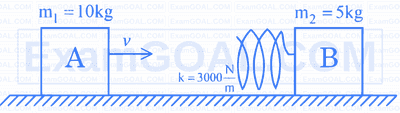
Consider two blocks A and B of masses $m_1=10 \mathrm{~kg}$ and $\mathrm{m}_2=5 \mathrm{~kg}$ that are placed on a frictionless table. The block A moves with a constant speed $v=3 \mathrm{~m} / \mathrm{s}$ towards the block B kept at rest. A spring with spring constant $\mathrm{k}=3000 \mathrm{~N} / \mathrm{m}$ is attached with the block B as shown in the figure. After the collision, suppose that the blocks A and B, along with the spring in constant compression state, move together, then the compression in the spring is, (Neglect the mass of the spring)

Three equal masses $m$ are kept at vertices $(A, B, C)$ of an equilateral triangle of side a in free space. At $t=0$, they are given an initial velocity $\overrightarrow{V_A}=V_0 \overrightarrow{A C}, \overrightarrow{V_B}=V_0 \overrightarrow{B A}$ and $\overrightarrow{V_C}=V_0 \overrightarrow{C B}$. Here, $\overrightarrow{A C}, \overrightarrow{C B}$ and $\overrightarrow{B A}$ are unit vectors along the edges of the triangle. If the three masses interact gravitationally, then the magnitude of the net angular momentum of the system at the point of collision is :
JEE Main Subjects
Browse all chapters by subject