1
GATE ECE 2026
Numerical
+1
-0.33
The negative edge triggered $J K$ flip-flop in the Figure has $J$ and $K$ inputs tied to Logic High and a square wave of 10 cycles/second is applied to its clock $(C)$ input. The frequency of the output $Q$ (in cycles/second) is $\_\_\_\_$ .
(rounded off to two decimal places)

Your input ____
2
GATE ECE 2023
MCQ (Single Correct Answer)
+1
-0.33
The synchronous sequential circuit shown below works at a clock frequency of 1 GHz. The throughput, in Mbits/s, and the latency, in ns, respectively, are

3
GATE ECE 2018
Numerical
+1
-0
A traffic signal cycles from GREEN to YELLOW, YELLOW to RED and RED to GREEN.
In each cycle, GREEN is turned on for 70 seconds, YELLOW is turned on for
5 seconds and the RED is turned on for 75 seconds. This traffic light has to be implemented
using a finite state machine (FSM). The only input to this FSM is a clock of 5 second period.
The minimum number of flip-flops required to implement this FSM is _______.
Your input ____
4
GATE ECE 2017 Set 1
Numerical
+1
-0
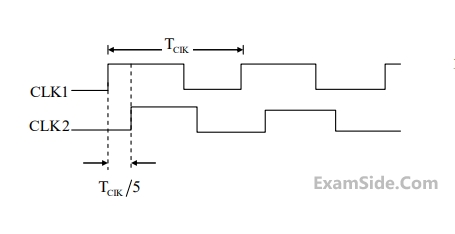
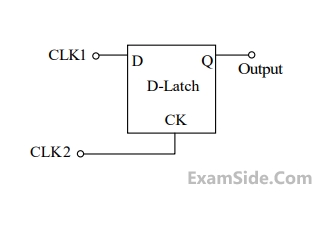
Consider the D-Latch shown in the figure, which is transparent when its clock input CK is high and has zero propagation delay. In the figure, the clock signal CLK1 has a 50% duty cycle and CLK2 is a one-fifth period delayed version of CLK1. The duty cycle at the output latch in percentage is ___________.
Your input ____
GATE ECE Subjects
Browse all chapters by subject
Control Systems
Engineering Mathematics
Analog Circuits
Network Theory
Electromagnetics
Electronic Devices and VLSI
Digital Circuits
Microprocessors
Signals and Systems
Discrete Time Signal Fourier Series Fourier Transform Continuous Time Signal Laplace Transform Fourier Transform Discrete Fourier Transform and Fast Fourier Transform Representation of Continuous Time Signal Fourier Series Discrete Time Linear Time Invariant Systems Transmission of Signal Through Continuous Time LTI Systems Transmission of Signal Through Discrete Time Lti Systems Miscellaneous Continuous Time Linear Invariant System Discrete Time Signal Z Transform Sampling
Communications
General Aptitude