Semiconductor Physics · Electronic Devices and VLSI · GATE ECE
Marks 1
Which of the following can be used as an n-type dopant for silicon?
Select the correct option(s).
For non-degenerately doped n-type silicon, which one of the following plots represents the temperature ($T$) dependence of free electron concentration ($n$)?
The free electron concentration profile $n(x)$ in a doped semiconductor at equilibrium is shown in the figure, where the points A, B, and C mark three different positions. Which of the following statements is/are true?

In a semiconductor, if the Fermi energy level lies in the conduction band, then the semiconductor is known as
For an intrinsic semiconductor at temperature $$T=0K$$, which of the following statement is true?
Consider a long rectangular bar of direct bandgap p-type semiconductor. The equilibrium hole density is 1017 cm$$-$$3 and the intrinsic carrier concentration is 1010 cm$$-$$3. Electron and hole diffusion lengthss are 2 $$\mu$$m and 1 $$\mu$$m, respectively. The left side of the bar (x = 0) is uniformly illuminated with a laser having photon energy greater than the bandgap of the semiconductor. Excess electron-hole pairs are generated ONLY at x = 0 because of the laser. The steady state electron density at x = 0 is 1014 cm$$-$$3 due to laser illumination. Under these conditions and ignoring electric field, the closest approximation (among the given options) of the steady state electron density at x = 2 $$\mu$$m, is _____________.
In a non-degenerate bulk semiconductor with electron density n = 1016 cm$$-$$3, the value of EC $$-$$ EFn = 200 meV, where EC and EFn denote the bottom of the conduction band energy and electron Fermi level energy, respectively. Assume thermal voltage as 26 meV and the intrinsic carrier concentration is 1010 cm$$-$$3. For n = 0.5 $$\times$$ 1016 cm$$-$$3, the closest approximation of the value of (EC $$-$$ EFn), among the given options is _________.
A single crystal intrinsic semiconductor is at a temperature of 300 K with effective density of states for holes twice that of electrons. The thermal voltage is 26 mV . The intrinsic Fermi level is shifted from midbandgap energy level by


The slope of the line can be used to estimate
Marks 2
Consider that the concentration of electrons in a semiconductor bar varies linearly from $2 \times 10^{17} \mathrm{~cm}^{-3}$ at $x=1 \mu \mathrm{~m}$ to $1 \times 10^{16} \mathrm{~cm}^{-3}$ at $x=4 \mu \mathrm{~m}$ along the $x$-direction. Assume that the concentration of electrons is not varying along other directions (that is along $y$ and $z$-directions).
[Given: the mobility of electron is $1400 \mathrm{~cm}^2 \mathrm{~V}^{-1} \mathrm{~s}^{-1}$, thermal voltage is 25 mV and electronic charge is $1.6 \times 10^{-19}$ Coulomb.]
The density of electron diffusion current (in $\mathrm{A} / \mathrm{mm}^2$ ) is $\_\_\_\_$ .
(rounded off to two decimal places)
The electron mobility $\mu_n$ in a non-degenerate germanium semiconductor at 300 K is $0.38 \mathrm{~m}^2 / \mathrm{Vs}$.
The electron diffusivity $D_n$ at 300 K (in $\mathrm{cm}^2 / \mathrm{s}$, rounded off to the nearest integer) is ____________
(Consider the Boltzmann constant $k_B=1.38 \times 10^{-23} \mathrm{~J} / \mathrm{K}$ and the charge of an electron $e=1.6 \times 10^{-19} \mathrm{C}$.)
A non-degenerate n-type semiconductor has 5 % neutral dopant atoms. Its Fermi level is located at 0.25 eV below the conduction band ($E_C$) and the donor energy level ($E_D$) has a degeneracy of 2. Assuming the thermal voltage to be 20 mV, the difference between $E_C$ and $E_D$ (in eV, rounded off to two decimal places) is _______.
In an extrinsic semiconductor, the hole concentration is given to be 1.5$$n_i$$ where $$n_i$$ is the intrinsic carrier concentration of 1 $$\times$$ 10$$^{10}$$ $$cm^{-3}$$. The ratio of electron to hole mobility for equal hole and electron drift current is given as ___________ (rounded off to two decimal places).
In a semiconductor device, the Fermi-energy level is 0.35 eV above the valence band energy. The effective density of states in the valence band at T = 300 K is 1 $$\times$$ 10$$^{19}$$ cm$$^{-3}$$. The thermal equilibrium hole concentration in silicon at 400 K is _____________ $$\times$$ 10$$^{13}$$ cm$$^{-3}$$ (rounded off to two decimal places).
Given kT at 300 K is 0.026 eV.
Select the CORRECT statements regarding semiconductor devices
A bar of silicon is doped with boron concentration of $10^{16} \mathrm{cm}^{-3}$ and assumed to be fully ionized. It is exposed to light such that electron-hole pairs are generated throughout the volume of the bar at the rate of $10^{20} \mathrm{~cm}^{-2} \mathrm{~s}^{-1}$. If the recombination lifetime is $100 \mu \mathrm{~s}$, intrinsic carrier concentration of silicon is $10^{10} \mathrm{~cm}^{-3}$ and assuming $100 \%$ ionization of boron, then the approximate product of steady-state electron and hole concentrations due to this light exposure is
The energy band diagram of a $p$-type semiconductor bar of length $L$ under equilibrium condition (i.e., the Fermi energy level $E_F$ is constant) is shown in the figure. The valance band $E_V$ is sloped since doping is non-uniform along the bar. The different between the energy levels of the valence band at the two edges of the bar is $\Delta$.
 If the charge of an electron is $q$, then the magnitude of the electric field developed inside the semiconductor bar is
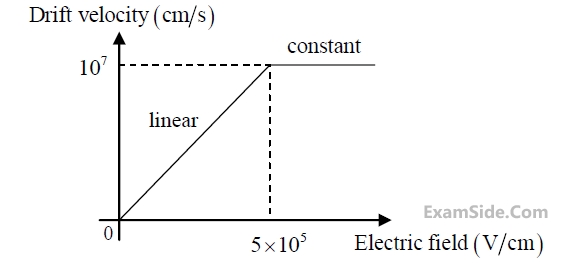


If EC is the lowest energy level of the conduction band, EV is the highest energy level of the valance band and EF is the Fermi level, which one of the following represents the energy band diagram for the biased N-type semiconductor?
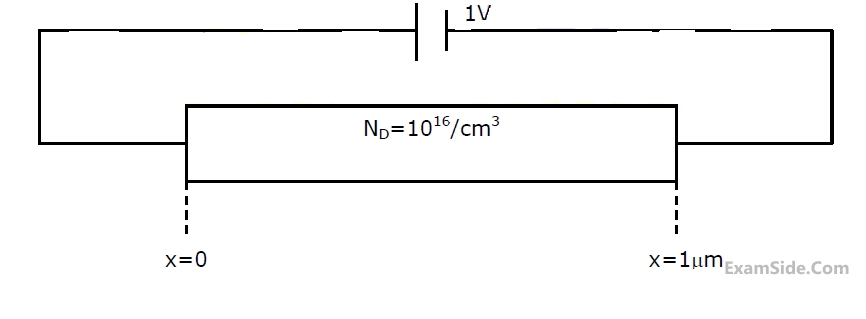
The magnitude of the electron drift current density at x=0.5 μm is
The magnitude of the electric field at x=0.5 μm is