Antennas · Electromagnetics · GATE ECE
Marks 1
Consider the Friis' transmission equation $P_R=\left(P_T G_T G_R \lambda^2\right) /(4 \pi D)^2$, where $P_R$ and $P_T$ are the received and the transmitted powers, respectively.
$G_T$ and $G_R$ are the gain of transmitting and receiving antennas, respectively, $D$ is the distance between the transmitting and receiving antennas, and $\lambda$ is the wavelength in free space.
Given: $G_T=G_R=1.0, \lambda=0.30 \mathrm{~m}$ and $P_T=+10 \mathrm{dBm}$.
Choose the distance (D), in km , from the following options at which the received power, $P_R=-90 \mathrm{dBm}$ ?
An antenna with a directive gain of 6 dB is radiating a total power of 16 kw . The amplitude of the electric field in free space at a distance of 8 km from the antenna in the direction of 6 dB gain(rounded off to three decimal places is$\_\_\_\_$ $\mathrm{V} / \mathrm{m}$.
Column
1. Point electromagnetic source
2. Dish antenna
3. Yagi-Uda antenna
Column
P. Highly directional
Q. End fire
R. Isotropic
Marks 2
For an infinitesimally small dipole in free space, the electric field $E_\theta$ in the far field is proportional to $\frac{e^{-j k r}}{r} \sin \theta$, where $k=\frac{2 \pi}{\lambda}$. A vertical infinitesimally small electric dipole ( $\delta l \ll \lambda$ ) is placed at a distance $h(h>0)$ above an infinite ideal conducting plane, as shown in the figure. The minimum value of $h$, for which one of the maxima in the far field radiation pattern occurs at $\theta=60^{\circ}$, is

The radiated power density is symmetrical with respect to $$\phi $$ and exists only in the upper hemisphere: $$0 \le \theta \le {\pi \over 2};\,\,\,\,0 \le \theta \le 2\pi ;$$
$${C_0}$$ is a constant. The power radiated by the antenna (in watts) and the maximum directivity of the antenna, respectively, are

Marks 4
Marks 5
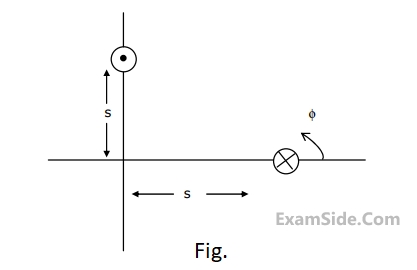
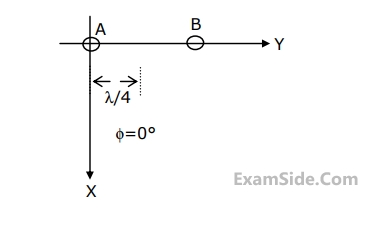
(a) Obtain the expression for the radiation pattern for E in the XY plane, i.e.,$$\left( {\theta = {{90}^0}} \right)$$.
(b) Sketch the radiation pattern obtained in (a).


(a) Write down the expression for the corresponding magnetic field strength vector.
(b) Calculate the frequency of the wave.
(C) Give the complete description of the polarization of the wave.

Marks 8

Marks 10
(a) equal and in - phase currents (Broadside array)
(b) equal currents but with a phase difference of 5400 between the two currents (End fire array)