1
GATE ECE 2010
MCQ (Single Correct Answer)
+2
-0.6
The silicon sample with unit cross-sectional area shown below is in thermal
equilibrium. The following information is given: T=300K, electronic charge=1.6x10-
19C, thermal voltage=26mV and electron mobility = 1350cm2/V-s
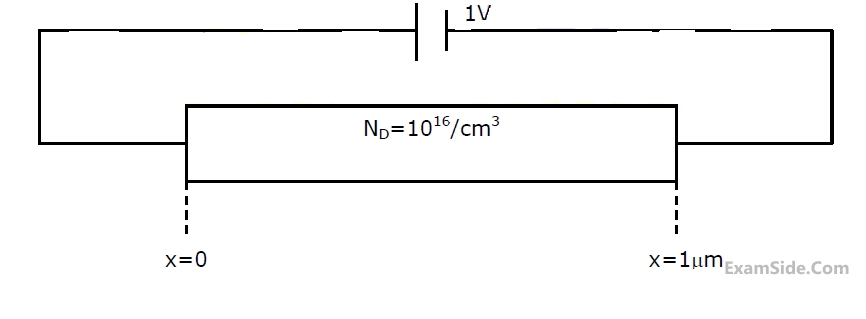
The magnitude of the electric field at x=0.5 μm is
2
GATE ECE 2005
MCQ (Single Correct Answer)
+2
-0.6
A silicon sample 'A' is doped with 1018 atoms/cm3 of Boron. Another sample 'B' of
identical dimensions is doped with 1018 atoms/cm3 of Phosphorus. The ratio of
electron to hole mobility is 1/3. The ratio of conductivity of the sample A to B is
3
GATE ECE 2003
MCQ (Single Correct Answer)
+2
-0.6
An n-type silicon bar 0.1 cm long and $$100\;\mu m^2$$ in cross-sectional area has a majority
carrier concentration of $$5\times10^{20}/m^3$$ and the carrier mobility is $$0.13\;\;m^2/v-s\;$$ at
300oK. if the charge of an electron is 1.6×10⁻¹⁹ coulomb, then the resistance of the
bar is
4
GATE ECE 2003
MCQ (Single Correct Answer)
+2
-0.6
The electron concentration in a sample of uniformly doped n-type silicon at 300oK varies linearly from $$10^{17}/cm^3$$ at x = 0 to $$6\times10^{16}/cm^3$$ at x = 2 $$\mu m$$. Assume a situation that electrons are supplied to keep this concentration gradient constant with time.If electronic charge is $$1.6\times10^{-19}\;coulomb$$ and the diffusion constant $$D_n=3\;cm^2/s$$, the current density in the silicon, if no electric field is present is
GATE ECE Subjects
Browse all chapters by subject
General Aptitude
Network Theory
Microprocessors
Signals and Systems
Discrete Time Signal Fourier Series Fourier Transform Continuous Time Signal Laplace Transform Fourier Transform Discrete Fourier Transform and Fast Fourier Transform Representation of Continuous Time Signal Fourier Series Discrete Time Linear Time Invariant Systems Transmission of Signal Through Continuous Time LTI Systems Transmission of Signal Through Discrete Time Lti Systems Miscellaneous Continuous Time Linear Invariant System Discrete Time Signal Z Transform Sampling
Electromagnetics
Digital Circuits
Electronic Devices and VLSI
Control Systems
Communications
Engineering Mathematics