Four jobs are on order in a factory. As on day 20 of the production calendar, the corresponding due date and work remaining to complete these jobs (in days) are given in the table below.
$$ \begin{array}{|c|c|c|} \hline \text { Job } & \text { Due date } & \text { Work remaining (in days) } \\ \hline \text { M } & 26 & 5 \\ \hline \text { N } & 24 & 10 \\ \hline \text { O } & 28 & 10 \\ \hline \text { P } & 31 & 5 \\ \hline \end{array} $$
Which job(s) has/have critical ratio less than unity?
Parts P1 - P7 are machined first on a milling machine and then polished at a separate machine. Using the information in the following table, the minimum total completion time required for carrying out both the operations for all 7 parts is _______ hours.
|
Part |
Milling (hours) |
Polishing (hours) |
|
P1 |
8 |
6 |
|
P2 |
3 |
2 |
|
P3 |
3 |
4 |
|
P4 |
4 |
6 |
|
P5 |
5 |
7 |
|
P6 |
6 |
4 |
|
P7 |
2 |
1 |
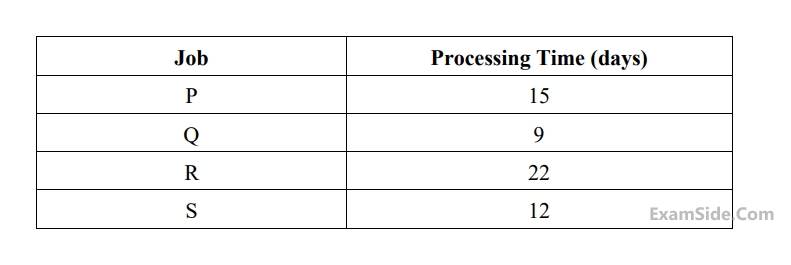

If the Earliest Due Date $$(EDD)$$ rule is used to sequence the jobs, the number of jobs delayed is
GATE ME Subjects
Browse all chapters by subject