Marks 1
Marks 2
A cylindrical pressure vessel made of steel has diameter of 3 m and wall thickness of 15 mm . For steel, Young's modulus and Poisson's ratio are 210 GPa and 0.3 , respectively. The cylinder is designed such that the allowable normal strain at the outer cylindrical surface is equal to 0.00034 . The permissible pressure in the tank is $\_\_\_\_$ kPa (rounded off to 1 decimal place).
The figure shows a thin cylindrical pressure vessel constructed by welding plates together along a line that makes an angle $\alpha = 60^\circ$ with the horizontal. The closed vessel has a wall thickness of 10 mm and diameter of 2 m. When subjected to an internal pressure of 200 kPa, the magnitude of the normal stress acting on the weld is _________ MPa (rounded off to 1 decimal place).

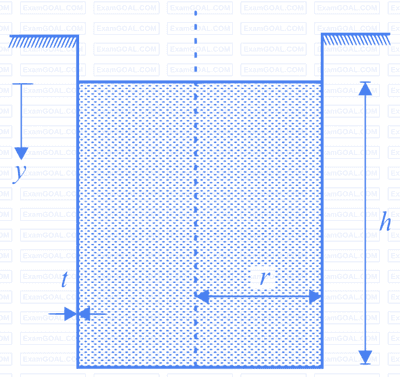
The figure shows a thin-walled open-top cylindrical vessel of radius 𝑟 and wall thickness 𝑡. The vessel is held along the brim and contains a constant-density liquid to height ℎ from the base. Neglect atmospheric pressure, the weight of the vessel and bending stresses in the vessel walls.
Which one of the plots depicts qualitatively CORRECT dependence of the magnitudes of axial wall stress (σ1) and circumferential wall stress (σ2) on 𝑦?

The axial and circumferential stress $$\left( {{\sigma _{a,}}\,{\sigma _c}} \right)$$ experienced by the cylinder wall a mid-depth ($$1$$ m as shown) are

If the Young's modulus and Poisson's ratio of the container material are $$100$$GPa and $$0.3$$, respectively. The axial strain in the cylinder wall at mid height is