1
GATE ECE 2006
MCQ (Single Correct Answer)
+2
-0.6
Let g(t) = p(t) * p(t), where * denotes convolution and p(t) = u(t) - (t-1) with u(t) being the unit step function. The impulse response of filter matched to the singal s(t) = g(t) - $$[\delta (t - 2)*g(t)]$$ is given as
2
GATE ECE 2005
MCQ (Single Correct Answer)
+2
-0.6
The output y(t) of a linear time invariant system is related to its input x(t) by the following equation: y(t) = 0.5 x $$(t - {t_d} + T) + \,x\,(t - {t_d}) + 0.5\,x(t - {t_d} - T)$$. The filter transfer function $$H(\omega )$$ of such a system is given by
3
GATE ECE 2004
MCQ (Single Correct Answer)
+2
-0.6
A causal system having the transfer function H(s) = $${1 \over {s + 2}}$$, is excited with 10 u(t). The time at which the output reaches 99% of its steady state value is
4
GATE ECE 2004
MCQ (Single Correct Answer)
+2
-0.6
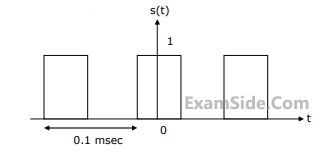
A rectangular pulse train s(t) as shown in Fig.1 is convolved with the signal $${\cos ^2}$$ ($$4\pi \,{10^{3\,}}$$t). The convolved signal will be a
GATE ECE Subjects
Browse all chapters by subject
Control Systems
Engineering Mathematics
Analog Circuits
Network Theory
Electromagnetics
Electronic Devices and VLSI
Digital Circuits
Microprocessors
Signals and Systems
Discrete Time Signal Fourier Series Fourier Transform Continuous Time Signal Laplace Transform Fourier Transform Discrete Fourier Transform and Fast Fourier Transform Representation of Continuous Time Signal Fourier Series Discrete Time Linear Time Invariant Systems Transmission of Signal Through Continuous Time LTI Systems Transmission of Signal Through Discrete Time Lti Systems Miscellaneous Continuous Time Linear Invariant System Discrete Time Signal Z Transform Sampling
Communications
General Aptitude