1
GATE ECE 2001
Subjective
+5
-0
A feedback control system is shown in figure
 (a) Draw the signal-flow graph that represents the system.
(b) Find the total number of loops in the graph and determine the loop-gains of all the loops.
(c) Find the number of all possible combination of non-touching loops taken two at a time.
(d) Determine the transfer function of the system using the signal-flow graph.
(a) Draw the signal-flow graph that represents the system.(b) Find the total number of loops in the graph and determine the loop-gains of all the loops.
(c) Find the number of all possible combination of non-touching loops taken two at a time.
(d) Determine the transfer function of the system using the signal-flow graph.
2
GATE ECE 1998
Subjective
+5
-0
Draw a signal flow graph for the following set of algebraic equations:
$$$\begin{array}{l}y_2=ay_1-\;gy_3\\y_3=ey_2+\;cy_4\\y_4=by_2-dy_4\end{array}$$$
Hence, find the gains $$\frac{y_2}{y_1}$$ and $$\frac{y_3}{y_1}$$.
3
GATE ECE 1994
Subjective
+5
-0
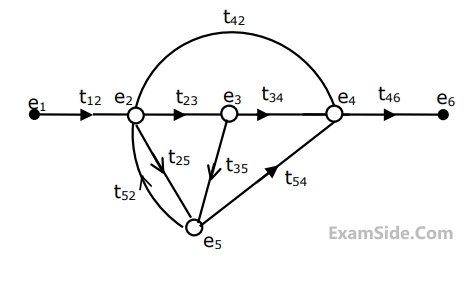
Reduce the signal flow graph shown in fig. below, to obtain another graph which does not contain the node e5.Also, remove any self-loop from the resulting graph.
GATE ECE Subjects
Browse all chapters by subject
General Aptitude
Network Theory
Microprocessors
Signals and Systems
Discrete Fourier Transform and Fast Fourier Transform Discrete Time Signal Fourier Series Fourier Transform Continuous Time Signal Laplace Transform Fourier Transform Representation of Continuous Time Signal Fourier Series Transmission of Signal Through Continuous Time LTI Systems Miscellaneous Sampling Continuous Time Linear Invariant System Discrete Time Linear Time Invariant Systems Discrete Time Signal Z Transform Transmission of Signal Through Discrete Time Lti Systems
Electromagnetics
Digital Circuits
Electronic Devices and VLSI
Control Systems
Communications
Engineering Mathematics