33% OFF
JEE Main Ultimate Online Test Series - 2027
331 Topic Tests87 Chapter Tests30 Full Tests10 Part Tests
- Most Relevant Questions for JEE Main 2027
- JEE Main Predictive Percentile and Rank
- Best Solution to Every Question
- Very Detailed Analysis
₹999 ₹1,499
Save ₹500
Access valid till 31 May 2027
1
JEE Advanced 2017 Paper 2 Offline
MCQ (Single Correct Answer)
+3
-0.75

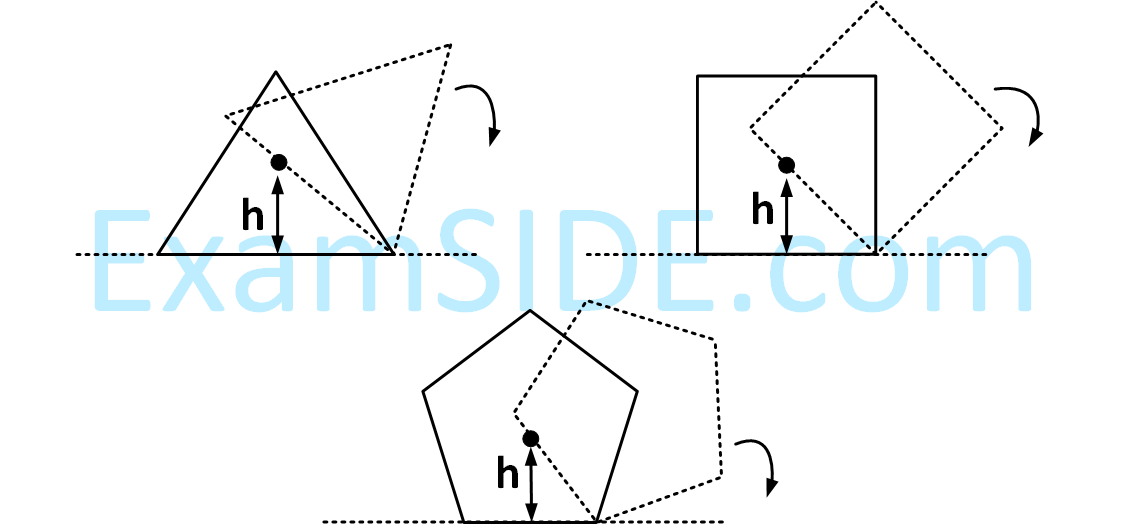
Consider regular polygons with number of sides $$n=3,4,5....$$ as shown in the figure. The center of mass of all the polygons is at height $$h$$ from the ground. They roll on a horizontal surface about the leading vertex without slipping and sliding as depicted. The maximum increase in height of the locus of the center of mass for each polygon is $$\Delta $$. Then $$\Delta $$ depends on $$n$$ and $$h$$ as
2
JEE Advanced 2017 Paper 2 Offline
MCQ (More than One Correct Answer)
+4
-1
Two coherent monochromatic point sources $${S_1}$$ and $${S_2}$$ of wavelength $$\lambda = 600\,nm$$ are placed symmetrically on either side of the center of the circle as shown. The sources are separated by a distance $$d=1.8$$ $$mm.$$ This arrangement produces interference fringes visible as alternate bright and dark spots on the circumference of the circle. The angular separation between two consecutive bright spots is $$\Delta \theta .$$ Which of the following options is/are correct?

3
JEE Advanced 2017 Paper 2 Offline
MCQ (More than One Correct Answer)
+4
-1
The instantaneous voltages at three terminals marked $$X,Y$$ and $$Z$$ are given by
$${V_x} = {V_0}\,\sin \,\omega t,$$
$${V_Y} = {V_0}\,\sin $$ $$\left( {\omega t + {{2\pi } \over 3}} \right)$$
and $$Vz = {V_0}\sin \left( {\omega t + {{4\pi } \over 3}} \right)$$
An ideal voltmeter is configured to read $$rms$$ value of the potential difference between its terminals. It is connected between points $$X$$ and $$Y$$ and then between $$Y$$ and $$Z.$$ The reading(s) of the voltmeter will be
$${V_x} = {V_0}\,\sin \,\omega t,$$
$${V_Y} = {V_0}\,\sin $$ $$\left( {\omega t + {{2\pi } \over 3}} \right)$$
and $$Vz = {V_0}\sin \left( {\omega t + {{4\pi } \over 3}} \right)$$
An ideal voltmeter is configured to read $$rms$$ value of the potential difference between its terminals. It is connected between points $$X$$ and $$Y$$ and then between $$Y$$ and $$Z.$$ The reading(s) of the voltmeter will be
4
JEE Advanced 2017 Paper 2 Offline
MCQ (Single Correct Answer)
+3
-0.75
A photoelectric material having work-function $${\phi _0}$$ is illuminated with light of wavelength $$\lambda \left( {\lambda < {{he} \over {{\phi _0}}}} \right).$$ The fastest photoelectron has a de-Broglic wavelength $${\lambda _d}.$$ A change in wavelength of the incident light by $$\Delta \lambda $$ result in a change $$\Delta {\lambda _d}$$ in $${\lambda _d}.$$ Then the ratio $$\Delta {\lambda _d}/\Delta \lambda $$ is proportional to
Paper Analysis
Total Questions
Chemistry 18
Mathematics 18
Physics 18
More Papers of JEE Advanced
JEE Advanced 2026 Paper 2 Online JEE Advanced 2026 Paper 1 Online JEE Advanced 2025 Paper 2 Online JEE Advanced 2025 Paper 1 Online JEE Advanced 2024 Paper 2 Online JEE Advanced 2024 Paper 1 Online JEE Advanced 2023 Paper 2 Online JEE Advanced 2023 Paper 1 Online JEE Advanced 2022 Paper 2 Online JEE Advanced 2022 Paper 1 Online JEE Advanced 2021 Paper 2 Online JEE Advanced 2021 Paper 1 Online JEE Advanced 2020 Paper 2 Offline JEE Advanced 2020 Paper 1 Offline JEE Advanced 2019 Paper 2 Offline JEE Advanced 2019 Paper 1 Offline JEE Advanced 2018 Paper 2 Offline JEE Advanced 2018 Paper 1 Offline JEE Advanced 2017 Paper 2 Offline JEE Advanced 2017 Paper 1 Offline JEE Advanced 2016 Paper 2 Offline JEE Advanced 2016 Paper 1 Offline JEE Advanced 2015 Paper 2 Offline JEE Advanced 2015 Paper 1 Offline JEE Advanced 2014 Paper 2 Offline JEE Advanced 2014 Paper 1 Offline JEE Advanced 2013 Paper 2 Offline JEE Advanced 2013 Paper 1 Offline IIT-JEE 2012 Paper 2 Offline IIT-JEE 2012 Paper 1 Offline IIT-JEE 2011 Paper 2 Offline IIT-JEE 2011 Paper 1 Offline IIT-JEE 2010 Paper 2 Offline IIT-JEE 2010 Paper 1 Offline IIT-JEE 2009 Paper 2 Offline IIT-JEE 2009 Paper 1 Offline IIT-JEE 2008 Paper 2 Offline IIT-JEE 2008 Paper 1 Offline IIT-JEE 2007 Paper 2 Offline IIT-JEE 2007 Paper 1 Offline IIT-JEE 2006 IIT-JEE 2005 Screening IIT-JEE 2005 IIT-JEE 2005 Mains IIT-JEE 2004 Screening IIT-JEE 2004 IIT-JEE 2003 Screening IIT-JEE 2003 IIT-JEE 2002 Screening IIT-JEE 2002 IIT-JEE 2001 Screening IIT-JEE 2001 IIT-JEE 2000 IIT-JEE 2000 Screening IIT-JEE 1999 Screening IIT-JEE 1999 IIT-JEE 1998 Screening IIT-JEE 1998 IIT-JEE 1997 IIT-JEE 1996 IIT-JEE 1995 Screening IIT-JEE 1995 IIT-JEE 1994 IIT-JEE 1993 IIT-JEE 1992 IIT-JEE 1991 IIT-JEE 1990 IIT-JEE 1989 IIT-JEE 1988 IIT-JEE 1987 IIT-JEE 1986 IIT-JEE 1985 IIT-JEE 1984 IIT-JEE 1983 IIT-JEE 1982 IIT-JEE 1981 IIT-JEE 1980 IIT-JEE 1979 IIT-JEE 1978
JEE Advanced Papers
All year-wise previous year question papers
2006
1997
1996
1994
1993
1992
1991
1990
1989
1988
1987
1986
1985
1984
1983
1982
1981
1980
1979
1978