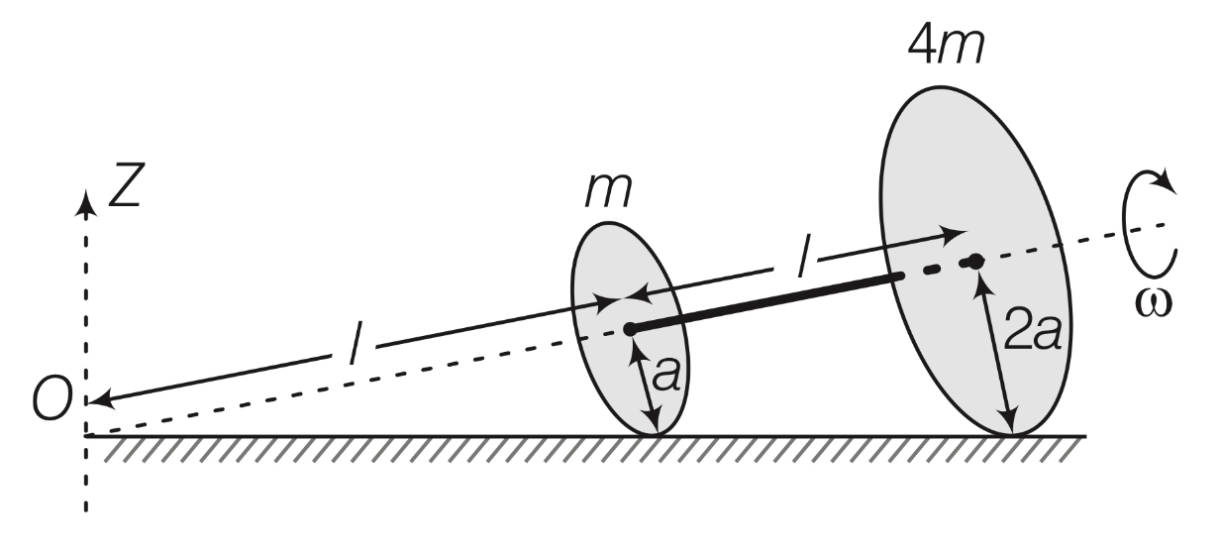
Two thin circular discs of mass m and 4m, having radii of a and 2a, respectively, are rigidly fixed by a
massless, rigid rod of length $$l = \sqrt {24} a$$ through their centers. This assembly is laid on a firm and flat
surface, and set rolling without slipping on the surface so that the angular speed about the axis of the rod is $$\omega $$. The angular momentum of the entire assembly about the point ‘O’ is $$\overrightarrow L $$ (see the figure). Which of the following statement(s) is(are) true?
A
The center of mass of the assembly rotates about the z-axis with an angular speed of $${\omega \over 5}$$
B
The magnitude of angular momentum of center of mass of the assembly about the point O is $$81\,m{a^2}\omega $$
C
The magnitude of angular momentum of the assembly about its center of mass is $${{17m{a^2}\omega } \over 2}$$
D
The magnitude of the z-component of $$\overrightarrow L $$
is $$55m{a^2}\omega $$
2
JEE Advanced 2016 Paper 1 Offline
MCQ (More than One Correct Answer)
+4
-2
The position vector $$\overrightarrow r $$ of a particle of mass m is given by the following equation
$$$\overrightarrow r \left( t \right) = \alpha {t^3}\widehat i + \beta {t^2}\widehat j,$$$where $$\alpha = {{10} \over 3}m{s^{ - 3}}$$, $$\beta = 5\,m{s^{ - 2}}$$ and m = 0.1 kg. At t = 1 s, which of the following
statement(s) is(are) true about the particle?
A
The velocity $$\overrightarrow v $$ is given by $$\overrightarrow v = \left( {10\widehat i + 10\widehat j} \right)$$ ms-1
B
The angular momentum $$\overrightarrow L $$
with respect to the origin is given by $$\overrightarrow L = - \left( {{5 \over 3}} \right)\widehat k\,N\,m\,s$$
C
The force $$\overrightarrow F $$
is given by $$\overrightarrow F = \left( {\widehat i + 2\widehat j} \right)N$$
D
The torque $$\overrightarrow \tau $$ with respect to the origin is given by $$\overrightarrow \tau = - \left( {{{20} \over 3}} \right)\widehat k\,N\,m$$
3
JEE Advanced 2015 Paper 1 Offline
MCQ (More than One Correct Answer)
+4
-2
A ring of mass M and radius R is rotating with angular speed $$\omega$$ about a fixed vertical axis passing through its centre O with two point masses each of mass $${M \over 8}$$ at rest at O. These masses can move radially outwards along two massless rods fixed on the ring as shown in the figure. At some instant, the angular speed of the system is $${8 \over 9}$$$$\omega$$ and one of the masses is at a distance of $${3 \over 5}$$R from O. At this instant, the distance of the other mass from O is
A
$${2 \over 3}$$R
B
$${1 \over 3}$$R
C
$${3 \over 5}$$R
D
$${4 \over 5}$$R
4
IIT-JEE 2012 Paper 2 Offline
MCQ (More than One Correct Answer)
+4
-1
The figure shows a system consisting of (i) a ring of outer radius 3R rolling clockwise without
slipping on a horizontal surface with angular speed $$\omega $$ and (ii) an inner disc of radius 2R rotating
anti-clockwise with angular speed $${\omega \over 2}$$. The ring and disc are separated by frictionless ball
bearings. The point P on the inner disc is at a distance R from the origin, where OP makes an
angle of $$30^\circ $$ with the horizontal. Then with respect to the horizontal surface,
A
the point O has linear velocity $$3R\omega \widehat i$$
B
the point P has linear velocity $${{11} \over 4}R\omega \widehat i + {{\sqrt 3 } \over 4}R\omega \widehat k$$
C
the point P has linear velocity $${{13} \over 4}R\omega \widehat i - {{\sqrt 3 } \over 4}R\omega \widehat k$$
D
the point P has linear velocity $$\left( {3 - {{\sqrt 3 } \over 4}} \right)R\omega \widehat i + {1 \over 4}R\omega \widehat k$$