Structure of Atom · Chemistry · JEE Advanced
Numerical
[Use :
Bohr radius, $\mathrm{a}=52.9 \mathrm{pm}$
Rydberg constant, $R_{\mathrm{H}}=2.2 \times 10^{-18} \mathrm{~J}$
Planck's constant, $\mathrm{h}=6.6 \times 10^{-34} \mathrm{~J} \mathrm{~s}$
Speed of light, $\mathrm{c}=3 \times 10^8 \mathrm{~m} \mathrm{~s}^{-1}$ ]
(Assume : Momentum is conserved when photon is absorbed.
Use : Planck constant = 6.6 $$\times$$ 10$$-$$34 J s, Avogadro number = 6 $$\times$$ 1023 mol$$-$$1, Molar mass of He = 4 g mol$$-$$1)
Use Avogadro constant as 6.023 $$ \times $$ 1023 mol-1.

| Metal | Li | Na | K | Mg | Cu | Ag | Fe | Pt | W |
|---|---|---|---|---|---|---|---|---|---|
| Ф (eV) | 2.4 | 2.3 | 2.2 | 3.7 | 4.8 | 4.3 | 4.7 | 6.3 | 4.75 |
MCQ (More than One Correct Answer)
The 2s and the 2p orbital energies of hydrogen atom are $E_{2s}({H})$ and $E_{2p}({H})$, respectively. The 2s and the 2p orbital energies of lithium atom are $E_{2s}({Li})$ and $E_{2p}({Li})$, respectively. The correct option(s) about the orbital energies is(are)
Among the following, the correct statement(s) for electrons in an atom is(are)
Which of the following statement(s) is(are) true for the state $$\psi $$?
MCQ (Single Correct Answer)
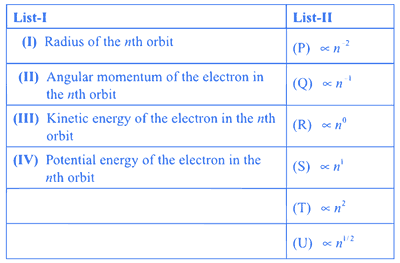
Which of the following options has the correct combination considering List-I and List-II?
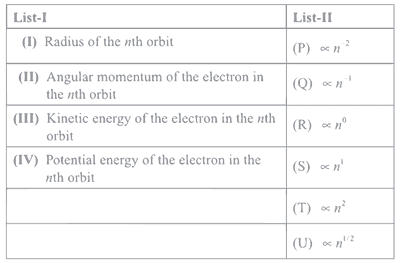
Which of the following options has the correct combination considering List-I and List-II?
The orbital angular momentum quantum number of the state S2 is
Energy of the state S1 in units of the hydrogen atom ground state energy is:
The state S1 is :
Match the entries in Column I with the correctly related quantum number(s) in Column II. Indicate your answer by darkening the appropriate bubbles of the 4 $$\times$$ 4 matrix given in the ORS.
| Column I | Column II | ||
|---|---|---|---|
| (A) | Orbital angular momentum of the electron in a hydrogen-like atomic orbital. | (P) | Principal quantum number |
| (B) | A hydrogen-like one-electron wave function obeying Pauli's principle. | (Q) | Azimuthal quantum number |
| (C) | Shape, size and orientation of hydrogen like atomic orbitals. | (R) | Magnetic quantum number |
| (D) | Probability density of electron at the nucleus in hydrogen-like atom. | (S) | Electron spin quantum number |
STATEMENT - 2 : Proton-proton electrostatic repulsions begin to overcome attractive forces involving protons and neutrons in heavier nuclides
A positron is emitted from $$_{11}^{23}$$Na The ratio of the atomic mass and atomic number of the resulting nuclide is :
En = Total energy, Kn = Kinetic Energy, Vn = Potential Energy, rn = Radius of nth orbit
Match the following
| Column I | Column II | ||
|---|---|---|---|
| (A) | $$\frac{V_n}{K_n} = ?$$ | (P) | 0 |
| (B) | If radius of $$n^{\text{th}}$$ orbit $$\propto E_n^x$$, $$x = ?$$ | (Q) | −1 |
| (C) | Angular momentum in lowest orbital | (R) | −2 |
| (D) | $$\frac{1}{r_n} \propto Z^y = ?$$ | (S) | 1 |
$$NO_3^-$$, $$CO_3^{2-}$$, $$ClO_3^-$$, SO3
Nuclide $${}_{13}^{30}Al$$ is less stable than $${}_{20}^{40}Ca$$
REASON:
Nuclides having odd number of protons and neutrons are generally unstable.
Subjective
(A) Calculate velocity of electron in the first orbit of hydrogen atom (Given : $$r=a_0=0.529$$ $$\mathop A\limits^o $$).
(B) Calculate the de Broglie's wavelength of the electron in first Bohr orbit.
(C) Calculate the orbital angular momentum of 2p orbital in terms of $$h/2\pi$$ units.
$$$\psi = {1 \over {4\sqrt {2\pi } }}{\left( {{1 \over {{a_0}}}} \right)^{3/2}}\left( {2 - {{{r_0}} \over {{a_0}}}} \right){e^{ - {r_0}/{a_0}}}$$$
Where a0 is Bohr's radius. If the radial node in 2s be at r0, then find r0 in terms of a0.
(b) A baseball having mass 100 g moves with velocity 100 m/s. Determine the value of wavelength of baseball.