Consider an electric dipole comprising two charges $+q$ and $-q$ each with mass $m$, separated by a fixed distance $d$ and initially at rest with its dipole moment pointing along $\hat{\imath}$. A uniform electric field $E \hat{\jmath}$ is turned on at time $t = 0$ and it is turned off at $t = t_f$, when the dipole moment makes an angle $\theta_f$ with $\hat{\imath}$. Neglecting any sources of energy loss, correct option(s) is/are :

A positive point charge of $10^{-8}$ C is kept at a distance of 20 cm from the center of a neutral conducting sphere of radius 10 cm. The sphere is then grounded and the charge on the sphere is measured. The grounding is then removed and subsequently the point charge is moved by a distance of 10 cm further away from the center of the sphere along the radial direction. Taking $\frac{1}{4\pi\epsilon_0} = 9 \times 10^9$ Nm$^2$/C$^2$ (where $\epsilon_0$ is the permittivity of free space), which of the following statements is/are correct:
Six infinitely large and thin non-conducting sheets are fixed in configurations I and II. As shown in the figure, the sheets carry uniform surface charge densities which are indicated in terms of $\sigma_0$. The separation between any two consecutive sheets is $1~\mu \text{m}$. The various regions between the sheets are denoted as 1, 2, 3, 4 and 5. If $\sigma_0 = 9~\mu\text{C/m}^2$, then which of the following statements is/are correct:
(Take permittivity of free space $\epsilon_0 = 9 \times 10^{-12}$ F/m)

A small electric dipole $\vec{p}_0$, having a moment of inertia $I$ about its center, is kept at a distance $r$ from the center of a spherical shell of radius $R$. The surface charge density $\sigma$ is uniformly distributed on the spherical shell. The dipole is initially oriented at a small angle $\theta$ as shown in the figure. While staying at a distance $r$, the dipole is free to rotate about its center.
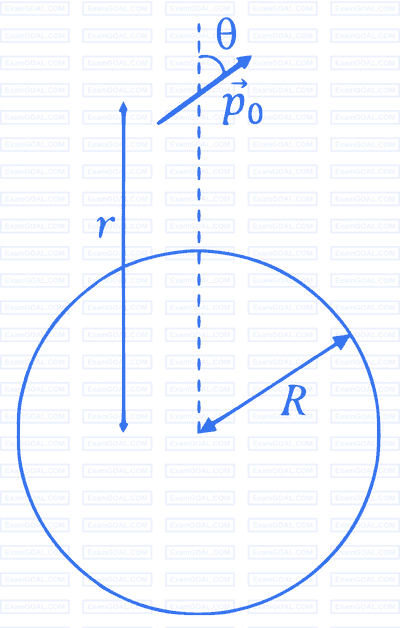
If released from rest, then which of the following statement(s) is(are) correct?
[ $\varepsilon_0$ is the permittivity of free space.]
JEE Advanced Subjects
Browse all chapters by subject