In a supplier-retailer supply chain, the demand of each retailer, the capacity of each supplier, and the unit cost in rupees of material supply from each supplier to each retailer are tabulated below. The supply chain manager wishes to minimize the total cost of transportation across the supply chain:
| Retailer I | Retailer II | Retailer III | Retailer IV | Capacity | |
|---|---|---|---|---|---|
| Supplier A | 11 | 16 | 19 | 13 | 300 |
| Supplier B | 5 | 10 | 7 | 8 | 300 |
| Supplier C | 12 | 14 | 17 | 11 | 300 |
| Supplier D | 8 | 15 | 11 | 9 | 300 |
| Demand | 300 | 300 | 300 | 300 |
The optimal cost of satisfying the total demand from all retailers is _____ rupees (answer in integer).
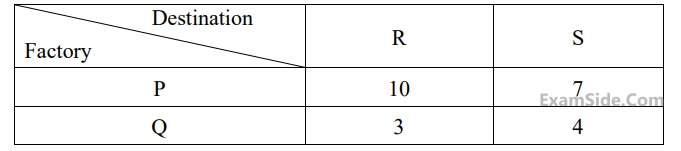
Factory $$P$$ produces $$7$$ units and factory $$Q$$ produces $$9$$ units of the product. Each destination requires $$8$$ units. If the north-west corner method provides the total transportation cost as $$X$$ (in Rupees) and the optimized (the minimum) total transportation cost $$Y$$ (in Rupees), then $$(X$$-$$Y),$$ in Rupees, is
GATE ME Subjects
Browse all chapters by subject