A block of mass 0.18 kg is attached to a spring of force-constant 2 N/m. The coefficient of friction between the block and the floor is 0.1. Initially the block is at rest and the spring is un-stretched. An impulse is given to the block as shown in the figure. The block slides a distance of 0.06 m and comes to rest for the first time. The initial velocity of the block in m/s is V = N/10. Then N is

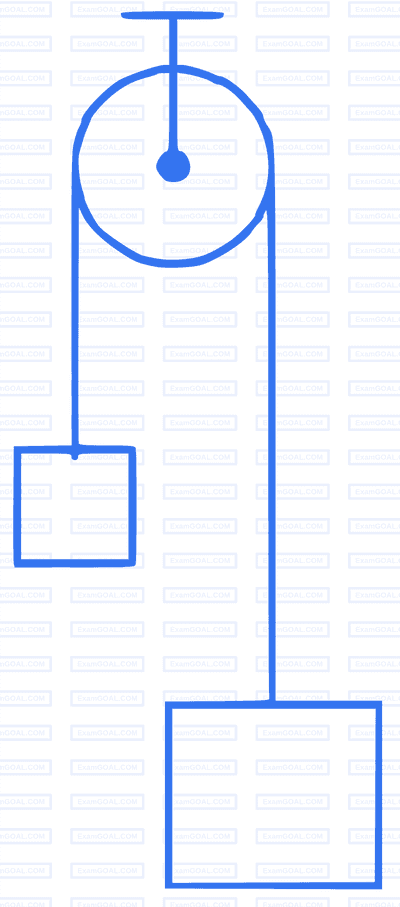
A light inextensible string that goes over a smooth fixed pulley as shown in the figure connects two blocks of masses 0.36 kg and 0.72 kg. Taking g = 10 m/s2, find the work done (in joules) by the string on the block of mass 0.36 kg during the first second after the system is released from rest.
Three objects A, B and C are kept in a straight line on a frictionless horizontal surface. These have masses m, 2m and m, respectively. The object A moves towards B with a speed 9 m/s and makes an elastic collision with it. Thereafter, B makes completely inelastic collision with C. All motions occur on the same straight line. Find the final speed (in m/s) of the object C.
There is a rectangular plate of mass M kg of dimensions ( $a \times b$ ). The plate is held in horizontal position by striking $n$ small balls each of mass m per unit area per unit time. These are striking in the shaded half region of the plate. The balls are colliding elastically with velocity $v$. What is $v$ ?
 It is given $n=100, \mathrm{M}=3 \mathrm{~kg}, m=0.01 \mathrm{~kg}$; $b=2 m ; a=1 \mathrm{~m} ; g=10 \mathrm{~m} / \mathrm{s}^2$
JEE Advanced Subjects
Browse all chapters by subject