1
JEE Advanced 2016 Paper 2 Offline
MCQ (More than One Correct Answer)
+4
-2

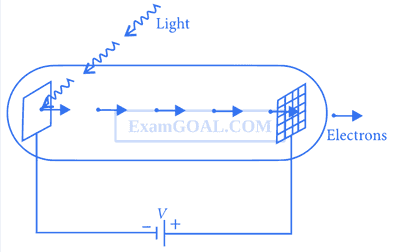
Light of wavelength $$\lambda$$ph falls on a cathode plate inside a vacuum tube as shown in the figure. The work function of the cathode surface is $$\phi$$ and the anode is a wire mesh of conducting material kept at a distance d from the cathode. A potential difference V is maintained between the electrodes. If the minimum de-Broglie wavelength of the electrons passing through the anode is $$\lambda$$e, which of the following statement(s) is (are) true?
2
JEE Advanced 2016 Paper 2 Offline
MCQ (Single Correct Answer)
+3
-0
A frame of the reference that is accelerated with respect to an inertial frame of reference is called a non-inertial frame of reference. A coordinate system fixed on a circular disc rotating about a fixed axis with a constant angular velocity $$\omega$$ is an example of a non-inertial frame of reference. The relationship between the force $$\overrightarrow F $$rot experienced by a particle of mass m moving on the rotating disc and the force $$\overrightarrow F $$in experienced by the particle in an inertial frame of reference is,
$$\overrightarrow F $$rot = $$\overrightarrow F $$in + 2m ($$\overrightarrow v $$rot $$\times$$ $$\overrightarrow \omega $$) + m ($$\overrightarrow \omega $$ $$\times$$ $$\overrightarrow r $$) $$\times$$ $$\overrightarrow \omega $$,
where, vrot is the velocity of the particle in the rotating frame of reference and r is the position vector of the particle with respect to the centre of the disc.
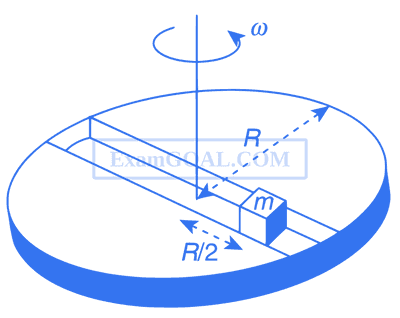
Now, consider a smooth slot along a diameter of a disc of radius R rotating counter-clockwise with a constant angular speed $$\omega$$ about its vertical axis through its centre. We assign a coordinate system with the origin at the centre of the disc, the X-axis along the slot, the Y-axis perpendicular to the slot and the Z-axis along the rotation axis ($$\omega$$ = $$\omega$$ $$\widehat k$$). A small block of mass m is gently placed in the slot at r = (R/2)$$\widehat i$$ at t = 0 and is constrained to move only along the slot.
The distance r of the block at time t is
$$\overrightarrow F $$rot = $$\overrightarrow F $$in + 2m ($$\overrightarrow v $$rot $$\times$$ $$\overrightarrow \omega $$) + m ($$\overrightarrow \omega $$ $$\times$$ $$\overrightarrow r $$) $$\times$$ $$\overrightarrow \omega $$,
where, vrot is the velocity of the particle in the rotating frame of reference and r is the position vector of the particle with respect to the centre of the disc.
Now, consider a smooth slot along a diameter of a disc of radius R rotating counter-clockwise with a constant angular speed $$\omega$$ about its vertical axis through its centre. We assign a coordinate system with the origin at the centre of the disc, the X-axis along the slot, the Y-axis perpendicular to the slot and the Z-axis along the rotation axis ($$\omega$$ = $$\omega$$ $$\widehat k$$). A small block of mass m is gently placed in the slot at r = (R/2)$$\widehat i$$ at t = 0 and is constrained to move only along the slot.
The distance r of the block at time t is
3
JEE Advanced 2016 Paper 2 Offline
MCQ (Single Correct Answer)
+3
-0
A frame of the reference that is accelerated with respect to an inertial frame of reference is called a non-inertial frame of reference. A coordinate system fixed on a circular disc rotating about a fixed axis with a constant angular velocity $$\omega$$ is an example of a non-inertial frame of reference. The relationship between the force $$\overrightarrow F $$rot experienced by a particle of mass m moving on the rotating disc and the force $$\overrightarrow F $$in experienced by the particle in an inertial frame of reference is,
$$\overrightarrow F $$rot = $$\overrightarrow F $$in + 2m ($$\overrightarrow v $$rot $$\times$$ $$\overrightarrow \omega $$) + m ($$\overrightarrow \omega $$ $$\times$$ $$\overrightarrow r $$) $$\times$$ $$\overrightarrow \omega $$,
where, vrot is the velocity of the particle in the rotating frame of reference and r is the position vector of the particle with respect to the centre of the disc.
Now, consider a smooth slot along a diameter of a disc of radius R rotating counter-clockwise with a constant angular speed $$\omega$$ about its vertical axis through its centre. We assign a coordinate system with the origin at the centre of the disc, the X-axis along the slot, the Y-axis perpendicular to the slot and the Z-axis along the rotation axis ($$\omega$$ = $$\omega$$ $$\widehat k$$). A small block of mass m is gently placed in the slot at r = (R/2)$$\widehat i$$ at t = 0 and is constrained to move only along the slot.
The net reaction of the disc on the block is
$$\overrightarrow F $$rot = $$\overrightarrow F $$in + 2m ($$\overrightarrow v $$rot $$\times$$ $$\overrightarrow \omega $$) + m ($$\overrightarrow \omega $$ $$\times$$ $$\overrightarrow r $$) $$\times$$ $$\overrightarrow \omega $$,
where, vrot is the velocity of the particle in the rotating frame of reference and r is the position vector of the particle with respect to the centre of the disc.
Now, consider a smooth slot along a diameter of a disc of radius R rotating counter-clockwise with a constant angular speed $$\omega$$ about its vertical axis through its centre. We assign a coordinate system with the origin at the centre of the disc, the X-axis along the slot, the Y-axis perpendicular to the slot and the Z-axis along the rotation axis ($$\omega$$ = $$\omega$$ $$\widehat k$$). A small block of mass m is gently placed in the slot at r = (R/2)$$\widehat i$$ at t = 0 and is constrained to move only along the slot.
The net reaction of the disc on the block is
4
JEE Advanced 2016 Paper 2 Offline
MCQ (Single Correct Answer)
+3
-0
Consider an evacuated cylindrical chamber of height h having rigid conducting plates at the ends and an insulating curved surface as shown in the figure. A number of spherical balls made of a light weight and soft material and coated with a conducting material are placed on the bottom plate. The balls have a radius r << h. Now, a high voltage source (HV) connected across the conducting plates such that the bottom plate is at +V0 and the top plate at $$-$$V0. Due to their conducting surface, the balls will get charge, will become equipotential with the plate and are repelled by it. The balls will eventually collide with the top plate, where the coefficient of restitution can be taken to be zero due to the soft nature of the material of the balls. The electric field in the chamber can be considered to be that of a parallel plate capacitor. Assume that there are no collisions between the balls and the interaction between them is negligible. (Ignore gravity)

Which one of the following statement is correct?
Which one of the following statement is correct?
Paper Analysis
Total Questions
Chemistry 18
Mathematics 18
Physics 18
More Papers of JEE Advanced
JEE Advanced 2026 Paper 2 Online JEE Advanced 2026 Paper 1 Online JEE Advanced 2025 Paper 2 Online JEE Advanced 2025 Paper 1 Online JEE Advanced 2024 Paper 2 Online JEE Advanced 2024 Paper 1 Online JEE Advanced 2023 Paper 2 Online JEE Advanced 2023 Paper 1 Online JEE Advanced 2022 Paper 2 Online JEE Advanced 2022 Paper 1 Online JEE Advanced 2021 Paper 2 Online JEE Advanced 2021 Paper 1 Online JEE Advanced 2020 Paper 2 Offline JEE Advanced 2020 Paper 1 Offline JEE Advanced 2019 Paper 2 Offline JEE Advanced 2019 Paper 1 Offline JEE Advanced 2018 Paper 2 Offline JEE Advanced 2018 Paper 1 Offline JEE Advanced 2017 Paper 2 Offline JEE Advanced 2017 Paper 1 Offline JEE Advanced 2016 Paper 2 Offline JEE Advanced 2016 Paper 1 Offline JEE Advanced 2015 Paper 2 Offline JEE Advanced 2015 Paper 1 Offline JEE Advanced 2014 Paper 2 Offline JEE Advanced 2014 Paper 1 Offline JEE Advanced 2013 Paper 2 Offline JEE Advanced 2013 Paper 1 Offline IIT-JEE 2012 Paper 2 Offline IIT-JEE 2012 Paper 1 Offline IIT-JEE 2011 Paper 2 Offline IIT-JEE 2011 Paper 1 Offline IIT-JEE 2010 Paper 1 Offline IIT-JEE 2010 Paper 2 Offline IIT-JEE 2009 Paper 2 Offline IIT-JEE 2009 Paper 1 Offline IIT-JEE 2008 Paper 2 Offline IIT-JEE 2008 Paper 1 Offline IIT-JEE 2007 Paper 2 Offline IIT-JEE 2007 Paper 1 Offline IIT-JEE 2006 IIT-JEE 2005 Screening IIT-JEE 2005 IIT-JEE 2005 Mains IIT-JEE 2004 IIT-JEE 2004 Screening IIT-JEE 2003 IIT-JEE 2003 Screening IIT-JEE 2002 Screening IIT-JEE 2002 IIT-JEE 2001 IIT-JEE 2001 Screening IIT-JEE 2000 IIT-JEE 2000 Screening IIT-JEE 1999 Screening IIT-JEE 1999 IIT-JEE 1998 Screening IIT-JEE 1998 IIT-JEE 1997 IIT-JEE 1996 IIT-JEE 1995 IIT-JEE 1995 Screening IIT-JEE 1994 IIT-JEE 1993 IIT-JEE 1992 IIT-JEE 1991 IIT-JEE 1990 IIT-JEE 1989 IIT-JEE 1988 IIT-JEE 1987 IIT-JEE 1986 IIT-JEE 1985 IIT-JEE 1984 IIT-JEE 1983 IIT-JEE 1982 IIT-JEE 1981 IIT-JEE 1980 IIT-JEE 1979 IIT-JEE 1978
JEE Advanced Papers
All year-wise previous year question papers
2006
1997
1996
1994
1993
1992
1991
1990
1989
1988
1987
1986
1985
1984
1983
1982
1981
1980
1979
1978