GATE ECE 2003
View Questions

GATE ECE

1
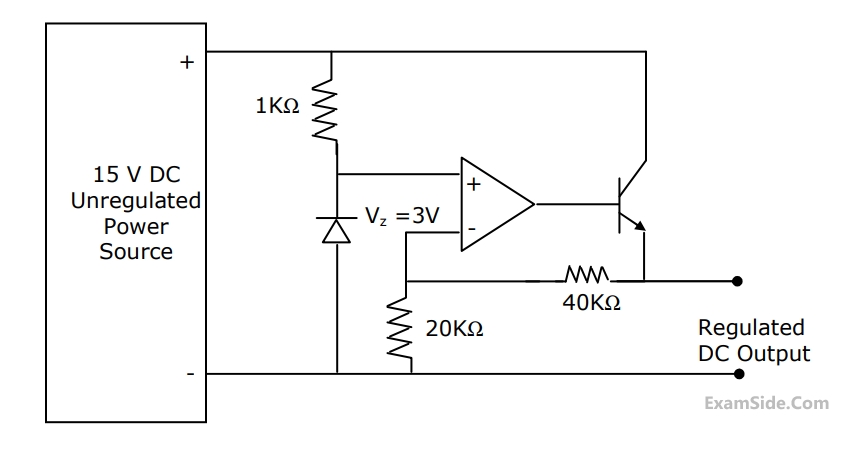
The output voltage of the Regulated power supply shown in the figure is GATE ECE 2003 Analog Circuits - Operational Amplifier Question 60 English
2
An amplifier without feedback has a voltage gain of 50, input Resistance of 1 k$$\Omega $$ and output Resistance of 2.5 k$$\Omega $$ . The input Resistance of the current-shunt negative feedback factor of 0.2 is
3
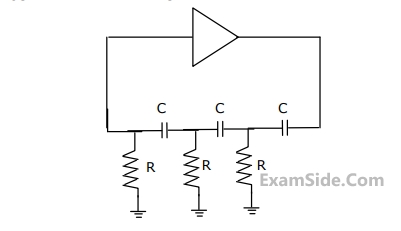
The oscillator circuit shown in the figure has an ideal inverting Amplifier. It's frequency of Oscillation (in Hz) is GATE ECE 2003 Analog Circuits - Oscillators Question 3 English
4
If the differential voltage gain and the common mode voltage gain of a differential Amplifier are 48 dB and 2 dB respectively, then it's common mode Rejection Ratio is
5
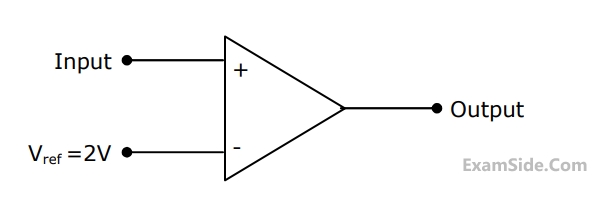
If the input to the ideal comparator shown in figure is sinusoidal signal of 8V (peak to peak) without any DC component, then the output of the comparator has a duty cycle of GATE ECE 2003 Analog Circuits - Operational Amplifier Question 61 English
6
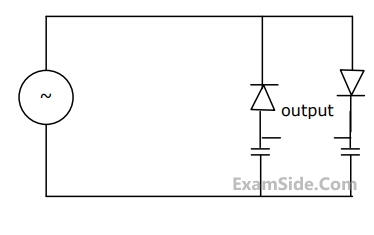
The circuit shown in figure is best described as a GATE ECE 2003 Analog Circuits - Diodes Question 21 English
7
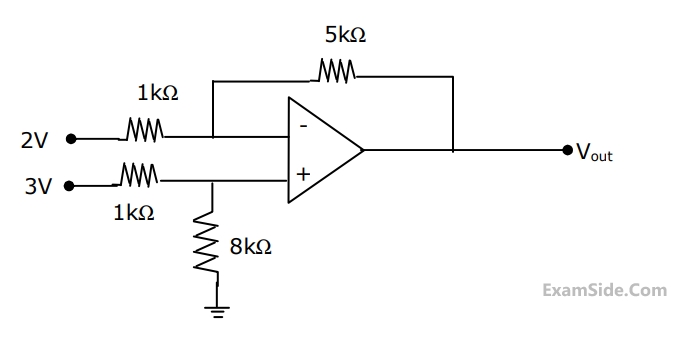
If the Op-Amp in the figure is ideal, the output voltage Vout will equal to GATE ECE 2003 Analog Circuits - Operational Amplifier Question 59 English
8
Generally, the gain of a transistor Amplifier falls at high frequency due to the
9
The action of a JFET in its equivalent circuit can be best represented as a
10
Three identical amplifiers with each one having a voltage gain of 50, input Resistance of 1 KΩ and output resistance of 250Ω, are cascaded. The open circuit voltage gain of the combined Amplifier is
11
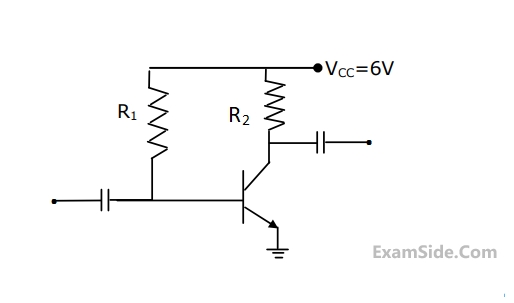
In the amplifier circuit shown in the figure, the values of R1 and R2 are such that the transistor is operating at VCE = 3V and IC = 1.5 mA when its $$\beta $$ is 150. For a transistor with $$\beta $$ of 200, the operating point (VCE, IC) is GATE ECE 2003 Analog Circuits - Bipolar Junction Transistor Question 47 English
12
If S represents the carrier synchronization at the receiver and $$\rho $$ represents the bandwidth efficiency, then the correct statement for the coherent binary PSK is
13
The input to a linear delta modulator having a step size $$\Delta $$ = 0.628 is a sine wave with frequency fm and peak amplitude Em. If the sampling frequency fs = 40 KHz. the combination of the sine-wave frequency and the amplitude, where slope overload will take place is
14
A signal is sampled at 8 KHz and is quantized using 8-bit uniform quantizer. Assuming $$SN{R_q}$$ for a sinusoidal signal, the correct statement for PCM signal with a bit rate of R is
15
A sinusoidal signal with peak-to-peak amplitude of 1.536V is quantized into 128 levels using a mid-rise uniform quantizer. The quantization-noise power is
16
If Eb, the energy per bit of a binary digital signal, is 10-5 watt-sec and the one-sided power spectral density of the white noise, N0 = 10-6 W/Hz, then the output SNR of the matched filter is
17
A DSB-SC signal is to be generated with a carrier frequency fc = 1MHz using a nonlinear device with the input-output characteristic $$v_0=a_0v_i\;+\;a_1v_i^3$$.where a0 and a1 are constants. The output of the nonlinear device can be filtered by an appropriate band-pass filter. Let $$v_0=A_c'\;\cos\left(2{\mathrm{πf}}_\mathrm c'\mathrm t\right)\;+\;m\left(t\right)$$ where m(t) is the message signal. Then the value of $$f_c'$$ (in MHz) is
18
Let $$m\left(t\right)\;=\cos\left[\left(4\mathrm\pi\times10^3\right)t\right]$$ be the message signal and $$c\left(t\right)\;=5\cos\left[2\mathrm\pi\times10^6t\right]$$ be the carrier.

c(t) and m(t) are used to generate an FM signal. If the peak frequency deviation of the generated FM signal is three times the transmission bandwidth of the AM singal, then the coefficient of the term $$\cos\left[2\mathrm\pi\left(1008\times10^3\right)t\right]$$ in the FM signal (in terms of the Bessel coefficients) is

19
Let $$m\left(t\right)\;=\cos\left[\left(4\mathrm\pi\times10^3\right)t\right]$$ be the message signal and $$c\left(t\right)\;=5\cos\left[2\mathrm\pi\times10^6t\right]$$ be the carrier.

c(t) and m(t) are used to generate an AM signal. The modulation index of the generated AM signal is 0.5. Then the quantity $$\frac{Total\;sideband\;power}{Carrier\;power}$$ is
20
Let x(t) be the input to a linear, time-invariant system. The required output is 4x(t-2). The transfer function of the system should be
21
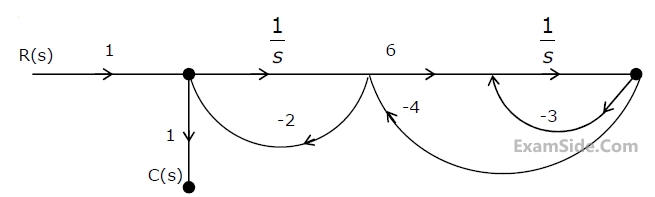
The signal flow graph of a system is shown in figure. The transfer function $$\frac{C(s)}{R(s)}$$ of the system is GATE ECE 2003 Control Systems - Signal Flow Graph and Block Diagram Question 19 English
22
A PD controller is used to compensate a system. Compared to the uncompensated system, the compensated system has
23
The zero, input response of a system given by the state space equation $$$\left[ {{{\mathop {{x_1}}\limits^ \bullet } \over {\mathop {{x_2}}\limits^ \bullet }}} \right] = \left[ {\matrix{ 1 & 0 \cr 1 & 1 \cr } } \right]\left[ {\matrix{ {{x_1}} \cr {{x_2}} \cr } } \right]and\left[ {\matrix{ {{x_1}} & {\left( 0 \right)} \cr {{x_2}} & {\left( 0 \right)} \cr } } \right] = \left[ {\matrix{ 1 \cr 0 \cr } } \right]is$$$
24
The gain margin and the phase margin of a feedback system with G(s)H(s)=$${s \over {{{\left( {s + 100} \right)}^3}}}$$ are
25
The gain margin for the system with open-loop transfer function G(s)H(s)=$${{2(1 + s)} \over {{s^2}}}$$ is
26
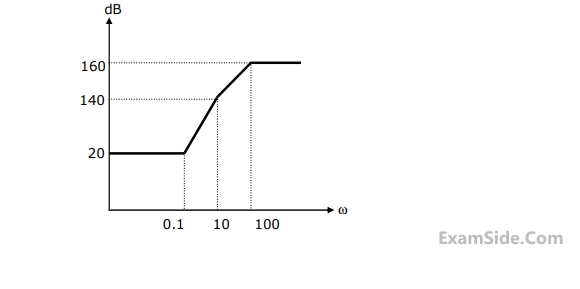
The approximate Bode magnitude plot of a minimum-phase system is shown in figure. The transfer function of the system is GATE ECE 2003 Control Systems - Frequency Response Analysis Question 40 English
27
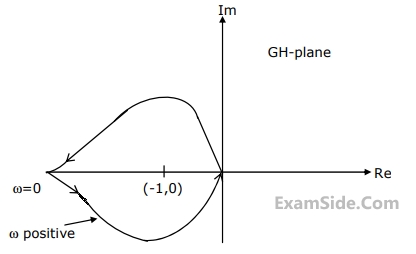
Figure shows the Nyquist plot of the open-loop transfer function G(s)H(s) of a system. If G(s)H(s) has one right hand pole, the closed loop system is GATE ECE 2003 Control Systems - Frequency Response Analysis Question 66 English
28
The open-loop transfer function of a unity feedback system is $$$G\left(s\right)=\frac k{s\left(s^2+s+2\right)\left(s+3\right)}$$$ the range of 'k' for which the system is stable
29
The root locus of the system $$$G\left(s\right)H\left(s\right)=\frac K{s\left(s+2\right)\left(s+3\right)}$$$ has the break-away point located at
30
A second-order system has the transfer function $$\frac{C\left(s\right)}{R\left(s\right)}=\frac4{s^2+4s+4}$$. With r(t) as the unit-step function, the response c(t) of the system is represented by
31
The output of the 74 series of TTL gates is taken from a BJT in
32
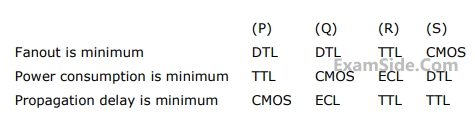
The DTL, TTL, ECL and CMOS families of digital ICs are compared in the following 4 columns GATE ECE 2003 Digital Circuits - Logic Families Question 4 English
33
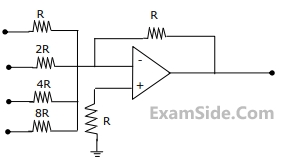
The circuit shown in figure is a 4-bit DAC GATE ECE 2003 Digital Circuits - Analog to Digital and Digital to Analog Converters Question 16 English The input bits 0 and 1 are represented by 0 and 5 V respectively. The OP- AMP is ideal, but all the resistances and the 5V inputs have a tolerance of ±10%.
The specification (rounded to the nearest multiple of 5%) for the tolerance of the DAC is

34
A 4 bit ripple counter and a 4 bit synchronous counter are made using flip-flops having a propagation delay of 10 ns each. If the worst case delay in the ripple counter and the synchronous counter be R and S respectively, then
35
A 0 to 6 counter consist of 3 flip-flops and a combination circuit of 2 input gate(s). The combination circuit consists of
36
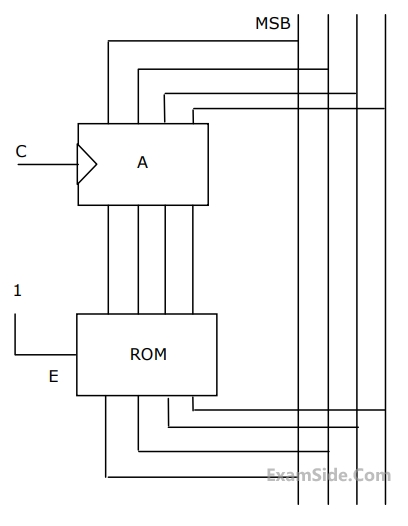
In the circuit shown in Figure, A is a parallel in, parallel-out 4-bit register, which loads at the rising edge of the clock C. The input lines are connected to a 4-bit bus, W. Its output acts as the input to a 16×4 ROM whose output is floating when the enable input E is 0. A partial table of the contents of the ROM is as follows GATE ECE 2003 Digital Circuits - Semiconductor Memories Question 4 English 1

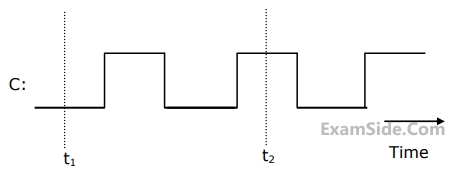
The clock to the register is shown, and the data on the W bus at time t$$_1$$ is 0110. The data on the bus at time t$$_2$$ is
GATE ECE 2003 Digital Circuits - Semiconductor Memories Question 4 English 2 GATE ECE 2003 Digital Circuits - Semiconductor Memories Question 4 English 3
37
With out any additional circuitry, an 8:1 MUX can be used to obtain
38
The number of distinct Boolean expressions of 4 variables is
39
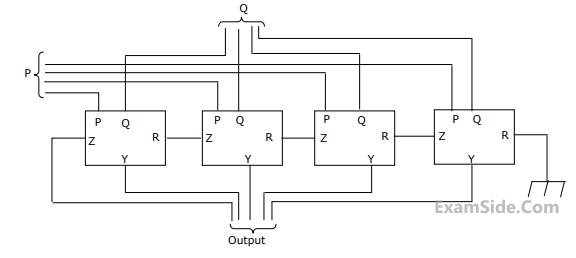
The circuit shown in figure has 4 boxes each described by inputs P, Q, R and outputs Y, Z with
Y = $$\,P \oplus \,Q\, \oplus \,R$$
z= $$RQ + \overline P R\, + Q\,\overline P $$ GATE ECE 2003 Digital Circuits - Combinational Circuits Question 37 English The circuit acts as a
40
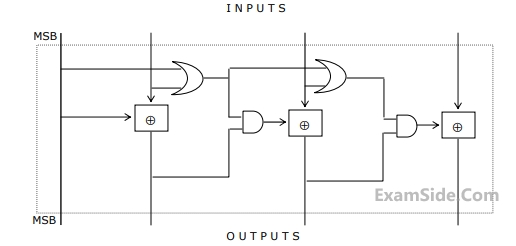
The circuit shown in figure converts GATE ECE 2003 Digital Circuits - Combinational Circuits Question 38 English
41
If the functions W, X, Y and Z are as follows

W= R+$$\overline P Q + \overline R $$ S
X = $$X = PQ\overline R \,\overline S + \overline P \,\overline Q \,\overline R \,\overline S + P\overline Q \,\overline R \,\overline S $$
Y = $$RS + \overline {OR + P\overline Q + \overline {PQ} } $$
Z = $$R + S + \overline {PQ + \overline {PQR} + P\overline {QS} } $$
42
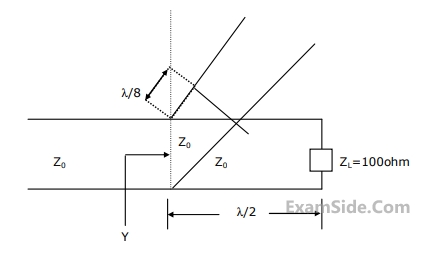
A short-circuited stub is shunt connected to a transmission line as shown in Fig. If $${Z_0} = 50\,\,\Omega $$, the admittance Y seen at the junction of the stub and the transmission line is GATE ECE 2003 Electromagnetics - Transmission Lines Question 36 English
43
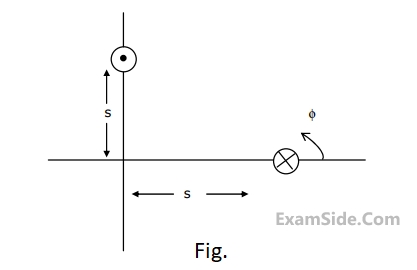
Two identical antennas are placed in the $$\theta = \pi /2$$ plane as shown in figure. The elements have equal amplitude excitation with 180° polarity difference, operating at wavelength λ. The correct value of the magnitude of the far zone resultant electric field strength normalized with that of a single element, both computed for $$\phi = 0$$ is GATE ECE 2003 Electromagnetics - Antennas Question 41 English
44
If the electric field intensity associated with a uniform plane electromagnetic wave traveling in a perfect dielectric medium is given by

$$E\left( {z,\,t} \right) = \,10\,\cos \left( {2\pi \times {{10}^7}\,\,t - 0.1\,\,\pi z} \right)\,$$ volt/m, the velocity of the traveling wave is

45
A rectangular metal wave guide filled with a dielectric material of relative permittivity $${\varepsilon _r} = \,4$$ has the inside dimensions $$3.0\,cm\,\, \times \,\,1.2\,cm$$. The cut-off frequency for the dominant mode is
46
Medium $$1$$ has the electrical permittivity $${\varepsilon _1} = 1.5\,\,{\varepsilon _0}\,\,\,F/m$$ and occupies the region to left of $$x = 0$$ plane. Medium $$2$$ has the electrical permittivity $${\varepsilon _2} = 2.5\,\,{\varepsilon _0}\,\,\,F/m$$ and occupies the region to the right of $$x = 0$$ plane. If $${E_1}$$ in medium $$1$$ is $${E_1} = \left( {2\,{u_x} - 3\,{u_y} + 1\,{u_z}} \right)$$ volt/m, then $${E_2}$$ in medium $$2$$ is
47
A uniform plane wave traveling in air is incident on the plane boundary between air and another dielectric medium with $${\varepsilon _r} = 4$$. The reflection coefficient for the normal incidence, is
48
The depth of penetration of electromagnetic wave in a medium having conductivity $$\sigma $$ at a frequency of 1 KHz is 25 cm. The depth of penetration at a frequency of 4 KHz will be
49
The unit of $$\nabla\times\mathrm H$$ is
50
If the electric field intensity is given by $$\mathrm E=\left(\mathrm x{\widehat{\mathrm u}}_\mathrm x\;+\mathrm y{\widehat{\mathrm u}}_\mathrm y+\mathrm z{\widehat{\mathrm u}}_\mathrm z\right)\;\mathrm{volt}/\mathrm m$$, the potential difference between X(2,0,0) and Y(1,2,3) is
51
At 300 K, for a diode current of 1 mA, a certain germanium diode requires a forward bias of 0.1435 V. Where as a certain silicon diode requires a forward bias of 0.718 V. Under the conditions stated above, the closest approximation of the ratio of reverse saturation current in germanium diode to that in silicon diode is
52
An n-type silicon bar 0.1 cm long and $$100\;\mu m^2$$ in cross-sectional area has a majority carrier concentration of $$5\times10^{20}/m^3$$ and the carrier mobility is $$0.13\;\;m^2/v-s\;$$ at 300oK. if the charge of an electron is 1.6×10⁻¹⁹ coulomb, then the resistance of the bar is
53
The electron concentration in a sample of uniformly doped n-type silicon at 300oK varies linearly from $$10^{17}/cm^3$$ at x = 0 to $$6\times10^{16}/cm^3$$ at x = 2 $$\mu m$$. Assume a situation that electrons are supplied to keep this concentration gradient constant with time.If electronic charge is $$1.6\times10^{-19}\;coulomb$$ and the diffusion constant $$D_n=3\;cm^2/s$$, the current density in the silicon, if no electric field is present is
54
n-type silicon is obtained by doping silicon with
55
Choose proper substitutes for X and Y to make the following statement correct Tunnel diode and Avalanche photodiode are operated in X bias and Y bias respectively.
56
When the gate-to-source voltage (VGS) of a MOSFET with threshold voltage of 400 mV, working in saturation is 900 mV, the drain current is observed to be 1 mA. Neglecting the channel width modulation effect and assuming that the MOSFET is operating at saturation, the drain current for an applied VGS of 1400 mV is
57
If P is Passivation, Q is n-well implant, R is metallization and S is source/drain diffusion, then the order in which they are carried out in a standard n-well CMOS fabrication process, is
58
For an n-channel enhancement type MOSFET, if the source is connected at a higher potential than that of the bulk (i.e. VSB > 0), the threshold voltage VT of the MOSFET will
59
The laplace transform of $$i(t)$$ is given by
$$I\left( s \right) = {2 \over {s\left( {1 + s} \right)}}$$ As $$t \to \infty ,$$ the value of $$i(t)$$ tends to __________.
60
In an 8085 microprocessor, the instruction CMP B has been executed while the content of the accumulator is less than that of register B. As a result
61
An input voltage $$v(t)$$ $$ = 10\sqrt 2 \,\,\cos \,\,\left( {t + {{10}^0}} \right) + 10\sqrt 5 \,\,\cos \left( {2t + {{10}^0}} \right)\,\,V$$ is applied to a series combination of resistance $$L = 1H$$. the resulting steady - state current $$i(t)$$ in ampere is
62
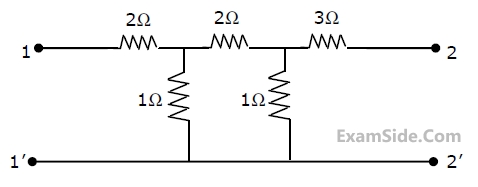
Find the Y-parameters (short ciruit admittance parameters) for the network shown in figure. GATE ECE 2003 Network Theory - Two Port Networks Question 22 English
63
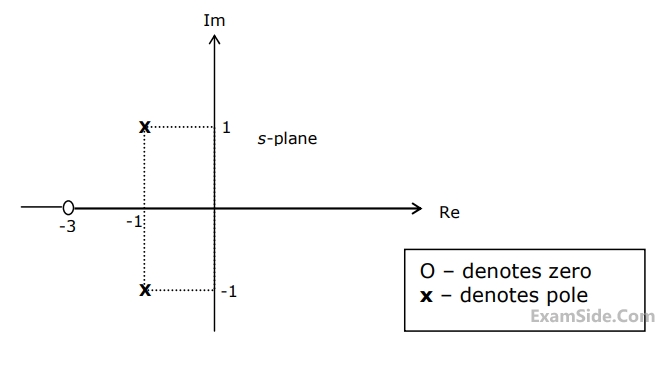
The driving-point impedance Z(s) of a network has the pole-zero locations as shown in figure. If Z(0) = 3, then Z(s) is GATE ECE 2003 Network Theory - Two Port Networks Question 32 English
64
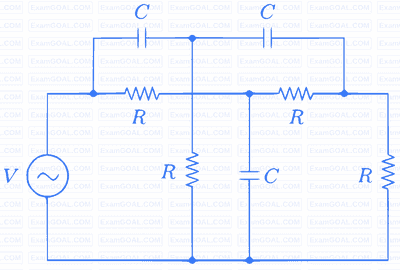
The impedance parameters Z11 and Z12 of the two-port network in figure are GATE ECE 2003 Network Theory - Two Port Networks Question 51 English
65
A series RLC circuit has a resonance frequency of 1 kHz and a quality factor Q = 100. If each R, L and C is doubled from its original value, the new Q of the circuit is
66

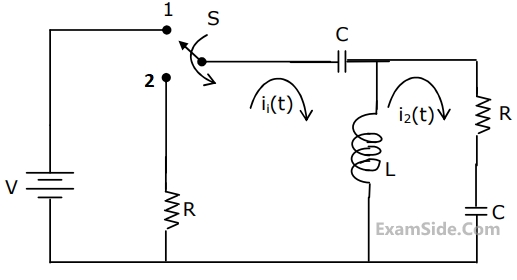
The circuit is given in figure.Assume that the switch S is in position 1 for a long time and thrown to position 2 at t = 0.
GATE ECE 2003 Network Theory - Transient Response Question 39 English

I1(s) and I2(s) are the Laplace transforms of i1(t) and i2(t) respectively. The equations for the loop currents I1(s) and I2(s) for the circuit shown in figure, after the switch is brought from position 1 to position 2 at t = 0, are

67

The circuit is given in figure.Assume that the switch S is in position 1 for a long time and thrown to position 2 at t = 0.

GATE ECE 2003 Network Theory - Transient Response Question 40 English

At t = 0+, the current i1 is

68
The minimum number of equations required to analyze the circuit shown in Fig. GATE ECE 2003 Network Theory - Network Graphs Question 3 English
69
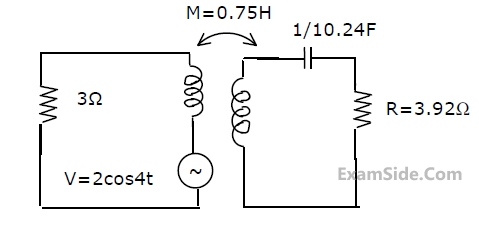
The current flowing through the resistance R in the circuit in figure has the form P cos 4t, where P is GATE ECE 2003 Network Theory - Sinusoidal Steady State Response Question 63 English
70

Twelve 1Ω resistances are used as edges to form a cube. The resistance between two diagonally opposite corners of the cube is

71
An ideal sawtooth voltage waveform of a frequency 500 Hz and Amplitude 3 V is generated by charging a capacitor of 2 $$\mu F$$ in every cycle the charging requires
72
A source of angular frequency 1rad/sec has source impedance consisting of $$1\Omega$$ resistance in series with 1H inductance. The load that will obtain maximum power transfer is
73
A sequence $$x\left( n \right)$$ with the $$z$$-transform $$X\left( z \right)$$ $$ = {z^4} + {z^2} - 2z + 2 - 3{z^{ - 4}}$$ is applied as an input to a linear, time-invariant system with the impulse response $$h\left( n \right) = 2\delta \left( {n - 3} \right)$$
where $$\matrix{ {\delta \left( n \right) = 1,} & {n = 0} \cr {0,} & {otherwise} \cr } $$

The output at $$n = 4$$ is
74
Let x(t) be the input to a linear, time-invariant system. The required output is 4x(t - 2). The transfer function of the system should be
75
The Laplace transform of i(t) tends to
$$I\left( s \right)\,\, = \,{2 \over {s\left( {1 + s} \right)}}$$

As $$t \to \infty $$ , the value of i(t) tends to

76
The system under consideration is an RC low -pass filter (RC-LPF) with R = 1.0 $$k\Omega $$ and C = 1.0 $$\mu F$$.

Let $${t_g}$$ (f) be the group delay function of the given RC-LPF and $${f_2}$$ = 100 Hz. Then $${t_g}$$$${(f_2)}$$ in ms, is
77
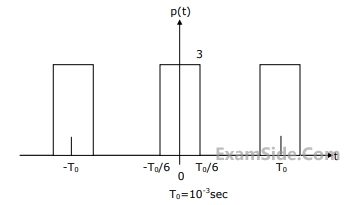
Let x(t) = $$\,2\cos (800\pi t) + \cos (1400\pi t)$$. x(t) is sampled with the rectangular pulse train shown in figure. The only spectral components (in KHz) present in the sampled signal in the frequency range 2.5 kHz to 3.5 kHz are GATE ECE 2003 Signals and Systems - Sampling Question 13 English
78
Let P be linearity, Q be time-invariance, R be causality and S be stability.

A discrete time system has the input-output relationship,


$$y\left( n \right) = \left\{ {\matrix{ {x\left( n \right),} & {n \ge 1} \cr {0,} & {n = 0} \cr {x\left( {n + 1} \right),} & {n \le - 1} \cr } } \right.$$

Where $$x\left( n \right)\,$$ is the input and $$y\left( n \right)\,$$ is the output. The above system has the properties

79
The system under consideration is an RC low -pass filter (RC-LPF) with R = 1.0 $$k\Omega $$ and C = 1.0 $$\mu F$$.

Let H(t) denote the frequency response of the RC-LPF. Let $${f_1}$$ be the highest frequency such that $$0 \le \left| f \right| \le {f_1},{{\left| {H({f_1})} \right|} \over {H(0)}} \ge 0.95$$. Then $${f_1}$$ (in Hz) is