GATE ECE
A transistor having $$\alpha$$ = 0.99 and VBE = 0.7 V, is used in the circuit of the figure.What is the value of the collector current?


$${F_1}$$$$(A,\,B,\,C,\,D) = ABCD + \bar A\,\overline B \,\bar C\,\bar D$$
$${F_2}(A,\,B,\,C,\,D) = (A + B)(\bar A\, + \overline B + C)$$
$${F_3}(A,\,B,\,C,\,D) = \sum {13,15 + \sum {3,5} } $$
(a) What is the minimum size of the ROM required?
(b) Determine the data in each location of the ROM.


(A) draw K-map for outputs, W, X, Y, and Z.
(B) Obtain minimized expression for the outputs W, X, Y, and Z.
(a) Write down the expression for the corresponding magnetic field strength vector.
(b) Calculate the frequency of the wave.
(C) Give the complete description of the polarization of the wave.


$$i(t)$$$$ = 3 + 4\sin \left( {100t + {{45}^ \circ }} \right) + 4\sin \left( {300t + {{60}^ \circ }} \right)\,\,A$$.
The RMS value of the current and the power dissipated in the circuit are
$${{{V_0}\,(s)} \over {{V_s}\,(s)}} = - {1 \over {{{(CR\,s)}^2}}}$$, assume ideal OP-Amp

Two 2H inductance coils are connected in series and are also magnetically coupled to each other the coefficient of coupling being 0.1.The total inductance of the combination can be
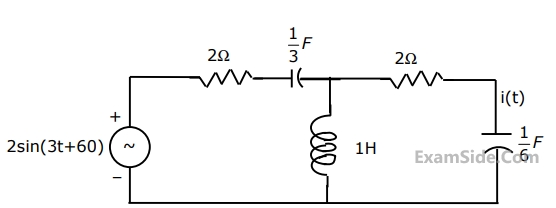
Determine the current, i(t), in the circuit given below, (Fig.), using the Thevenin's theorem.
The value of the resistance, R, connected across the terminals, A and B, (ref. Fig.), which will absorb the maximum power, is

A DC circuit shown in the figure has a voltage source V, a current source I and several resistors. A particular resistor R dissipates a power of 4 Watts when V alone is active. The same resistor R dissipates a power of 9 Watts when I alone is active. The power dissipated by R when both sources are active will be

where α is a constant. Determine the value of α.
A. Fourier transform of a Gaussian function
B. Convolution of a rectangular pulse with itself
C. Current through an inductor for a step input voltage
1. Gaussian function
2. Rectangular pulse
3. Triangular pulse Ramp function
4. Rump function
5. Zero