1
GATE EE 2021
MCQ (Single Correct Answer)
+2
-0.67
The causal signal with $z$-transform $z^2(z-a)^{-2}$ is ( $u[n]$ is the unit step signal)
2
GATE EE 2017 Set 2
MCQ (Single Correct Answer)
+2
-0.6
A cascade system having the impulse responses $$$\begin{array}{l}h_1\left(n\right)=\left\{1,\;-1\right\}\;\;\;and\;\;h_2\left(n\right)=\left\{1,\;1\right\}\\\;\;\;\;\;\;\;\;\;\;\;\;\;\;\;\;\uparrow\;\;\;\;\;\;\;\;\;\;\;\;\;\;\;\;\;\;\;\;\;\;\;\;\;\;\;\;\;\;\;\;\;\;\;\;\uparrow\end{array}$$$ is shown in the
figure below, where symbol $$\uparrow$$ denotes the time origin.
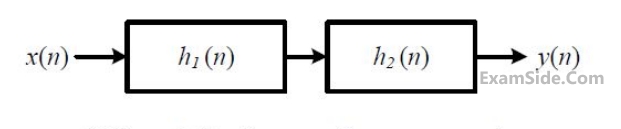 The input sequence x(n) for which the cascade system produces an output sequence
$$$\begin{array}{l}y\left(n\right)=\left\{1,\;2,\;1,\;-1,\;-2,\;-1\right\}\;\;is\\\;\;\;\;\;\;\;\;\;\;\;\;\;\;\;\uparrow\end{array}$$$
The input sequence x(n) for which the cascade system produces an output sequence
$$$\begin{array}{l}y\left(n\right)=\left\{1,\;2,\;1,\;-1,\;-2,\;-1\right\}\;\;is\\\;\;\;\;\;\;\;\;\;\;\;\;\;\;\;\uparrow\end{array}$$$
The input sequence x(n) for which the cascade system produces an output sequence
$$$\begin{array}{l}y\left(n\right)=\left\{1,\;2,\;1,\;-1,\;-2,\;-1\right\}\;\;is\\\;\;\;\;\;\;\;\;\;\;\;\;\;\;\;\uparrow\end{array}$$$
3
GATE EE 2015 Set 1
MCQ (Single Correct Answer)
+2
-0.6
Consider a discrete time signal given by
x[n]=(-0.25)nu[n]+(0.5)nu[-n-1]
The region of convergence of its Z-transform would be
x[n]=(-0.25)nu[n]+(0.5)nu[-n-1]
The region of convergence of its Z-transform would be
4
GATE EE 2014 Set 2
MCQ (Single Correct Answer)
+2
-0.6
A discrete system is represented by the difference equation
$$$\begin{bmatrix}X_1\left(k+1\right)\\X_2\left(k+2\right)\end{bmatrix}=\begin{bmatrix}a&a-1\\a+1&a\end{bmatrix}\begin{bmatrix}X_1\left(k\right)\\X_2\left(k\right)\end{bmatrix}$$$
It has initial condition $$X_1\left(0\right)=1;\;X_2\left(0\right)=0$$. The pole location of the system for a = 1,
are
GATE EE Subjects
Browse all chapters by subject
Electric Circuits
Electrical Machines
Engineering Mathematics
Signals and Systems
Power Electronics
Power System Analysis
Digital Electronics
Analog Electronics
Electromagnetic Fields
Control Systems
Electrical and Electronics Measurement
General Aptitude