1
GATE EE 2007
MCQ (Single Correct Answer)
+2
-0.6
$$X\left( z \right) = 1 - 3\,\,{z^{ - 1}},\,\,Y\left( z \right) = 1 + 2\,\,{z^{ - 2}}$$ are $$Z$$-transforms of two signals $$x\left[ n \right],\,\,y\left[ n \right]$$ respectively. A linear time invariant system has the impulse response $$h\left[ n \right]$$ defined by these two signals as $$h\left[ n \right] = x\left[ {n - 1} \right] * y\left[ n \right]$$ where $$ * $$ denotes discrete time convolution. Then the output of the system for the input $$\delta \left[ {n - 1} \right]$$
2
GATE EE 2007
MCQ (Single Correct Answer)
+2
-0.6
A signal is processed by a causal filter with transfer function $$G(s).$$ For a distortion free output signal waveform, $$G(s)$$ must.
$$G\left( z \right) = a{z^{ - 1}} + \beta \,\,{z^{ - 3}}$$ is a low-pass digital filter with a phase characteristic same as that of the above question if
3
GATE EE 2007
MCQ (Single Correct Answer)
+2
-0.6
A signal is processed by a causal filter with transfer function $$G(s).$$ For a distortion free output signal waveform, $$G(s)$$ must
4
GATE EE 2007
MCQ (Single Correct Answer)
+2
-0.6
Consider the discrete-time system shown in the figure where the impulse response of $$G\left( z \right)$$ is
$$g\left( 0 \right) = 0,\,\,g\left( 1 \right) = g\left( 2 \right) = 1,\,g\left( 3 \right) = g\left( 4 \right) = .... = 0$$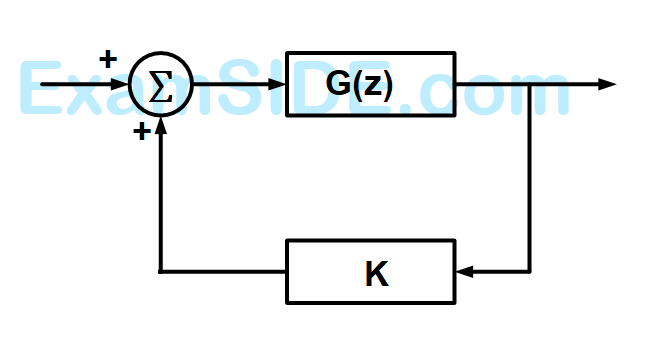
$$g\left( 0 \right) = 0,\,\,g\left( 1 \right) = g\left( 2 \right) = 1,\,g\left( 3 \right) = g\left( 4 \right) = .... = 0$$
This system is stable for range of values of $$K$$
GATE EE Subjects
Browse all chapters by subject
Electric Circuits
Electrical Machines
Engineering Mathematics
Signals and Systems
Power Electronics
Power System Analysis
Digital Electronics
Analog Electronics
Electromagnetic Fields
Control Systems
Electrical and Electronics Measurement
General Aptitude