1
GATE CSE 2009
MCQ (Single Correct Answer)
+2
-0.6
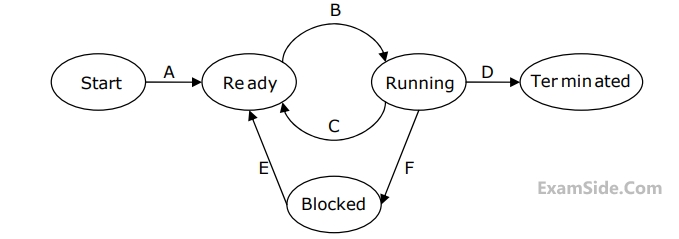
In the following process state transition diagram for a uniprocessor system, assume that there are always some processes in the ready state:
Now consider the following statements:
$$1.\,\,\,$$ If a process makes a transition $$D,$$ it would result in another process making transition $$A$$ immediately.
$$2.\,\,\,$$ $$A$$ process $${P_2}$$ in blocked state can make transition $$E$$ while another process $${P_1}$$ is in running state.
$$3.\,\,\,$$ The $$OS$$ uses preemptive scheduling.
$$4.\,\,\,$$ The $$OS$$ uses non-preemptive scheduling.
Which of the above statements are TRUE?
2
GATE CSE 2008
MCQ (Single Correct Answer)
+2
-0.6
A process executes the following code
for (i = 0; i < n; i + +) fork ( ); 3
GATE CSE 2008
MCQ (Single Correct Answer)
+2
-0.6
Which of the following is/are true of the auto-increment addressing mode?
$${\rm I}.\,\,\,$$ It is useful in creating self-relocating code
$${\rm II}.\,\,\,$$ If it is included in an Instruction Set Architecture, then an additional $$ALU$$ is required for effective address calculation.
$${\rm III}.\,\,\,$$ The amount of increment depends on the size of the data item accessed
$${\rm I}.\,\,\,$$ It is useful in creating self-relocating code
$${\rm II}.\,\,\,$$ If it is included in an Instruction Set Architecture, then an additional $$ALU$$ is required for effective address calculation.
$${\rm III}.\,\,\,$$ The amount of increment depends on the size of the data item accessed
4
GATE CSE 2007
MCQ (Single Correct Answer)
+2
-0.6
An operating system uses Shortest Remaining Time first $$(SRT)$$ process scheduling algorithm. Consider the arrival times and execution times for the following processes:
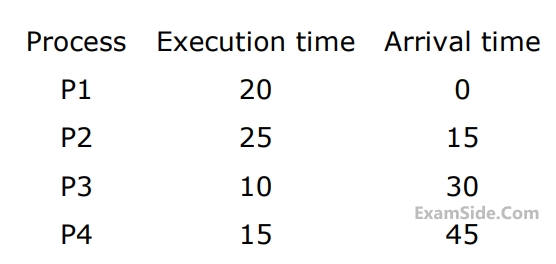
What is the total waiting time for process $$P2?$$
GATE CSE Subjects
Browse all chapters by subject
Theory of Computation
Operating Systems
Algorithms
Database Management System
Data Structures
Computer Networks
Software Engineering
Compiler Design
Web Technologies
General Aptitude
Discrete Mathematics
Programming Languages