GATE ECE


The optimum threshold to achieve minimum bit error rate (BER) is
If the detection threshold is 1, the BER will be


 The gain (20 log $$\left| {G(s)} \right|$$ ) is 32 dB and -8dB at 1rad/s and 10rad/s respectively. The phase is negative for all $$\omega .$$ Then G(s) is
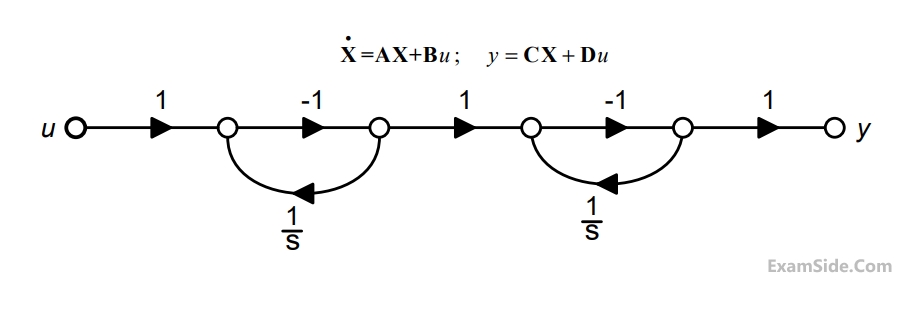
The state transition matrix eAt of the system shown in the figure above is
The state-variable equations of the system shown in the figure above are

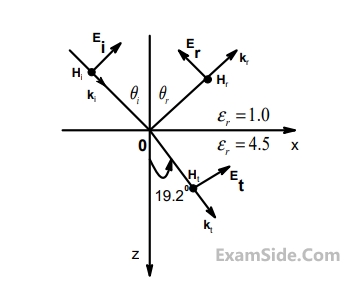
The angle of incidence $${\theta _i}$$ and the expression for $${\overrightarrow E _i}$$ are
The expression for $${\overrightarrow E _r}$$ is

kN = $${\mu _n}{C_{ox}^{'}}$$ (W/L)= 40$$\mu {\rm A}/{V^2},$$ threshold voltage VTN=1V, and neglect body effect and channel length modulation effects)

 At the end of program, accumulator contains
Consider a delta connection of resistors and its equivalent star connection as shown below. If all elements of the delta connection are scaled by a factor k, k > 0, the elements of the corresponding star equivalent will be scaled by a factor of

Consider the following figure

The current in the 1Ω resistor in Amps is
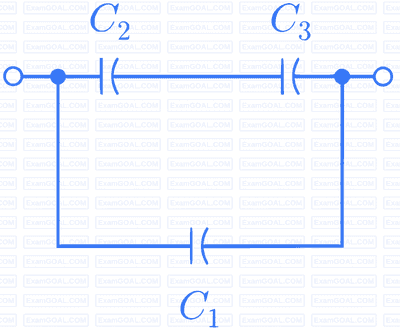
Three capacitors C1 ,C2 and C3 whose values are 10 µF, 5µF and 2µF respectively, have breakdown voltages of 10V, 5V, and 2V respectively. For the interconnection shown below, the maximum safe voltage in Volts that can be applied across the combination, and the corresponding total charge in µC stored in the effective capacitance across the terminals are respectively.
Consider the following figure
The current IS in Amps in the voltage source, and voltage VS in Volts across the current source respectively, are


Two magnetically uncoupled inductive coils have Q factors q1 and q2 at the chosen operating frequency. Their respective resistances are R1 and R2. When connected in series, their effective Q factor at the same operating frequency is
Let x(t) be a rectangular pulse given by $$$x\left( t \right) = \left\{ {\matrix{ {1\,\,\,\,\,\,\,\,\,0 \le \,t\, \le 2} \cr {0\,\,\,\,\,otherwise} \cr } } \right.$$$
Assuming that y(0) = 0 $${{dy} \over {dt}} = 0$$ at t = 0, the Laplace transform of y(t) is
 The DFT of the vector [ p q r s] is a scaled version of