A unit positive point charge is taken slowly through an infinitesimally thin tube that is inside a charged dielectric sphere of radius $R$, having uniform positive charge density $\rho$, as shown in the figure. The initial and final positions of the charge are marked by $A$ and $B$ at distance $2 R$ and $3 R$ respectively, from the centre of the sphere. In this process, the magnitude of the total work done on the point charge is $\frac{\rho R^2}{n \varepsilon_0}$. The value of $n$ is : ( $\varepsilon_0$ is the permittivity of vacuum)

Consider a fixed uniformly charged insulating sphere with radius $R$ and total charge $+Q$. A point charge $-q$ ( $q \ll Q$ ) with mass $m$ is released from rest at a distance of $3 R$ from the centre of the charged sphere. When the point charge reaches the surface of the sphere, its speed is:
( $\varepsilon_0$ is the permittivity of vacuum, neglect gravitational forces).
A point charge $Q$ is placed inside a cavity within a solid isolated conducting sphere. Consider points $A, B$ and $C$ as shown in the figure, where the magnitudes of the electric fields are $E_A, E_B, E_C$, respectively. The points $B$ and $C$ are at the same distance from the center of the solid sphere. The correct option is :
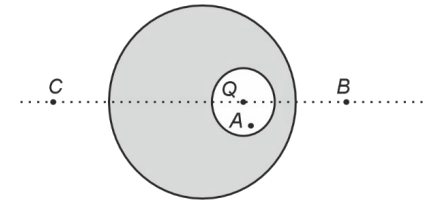

Which of the following statements are correct?
A. Inside a conductor, the electrostatic field is zero.
B. Electric field at the surface of a charged conductor does not depend on its surface charge density.
C. The interior of a charged conductor can have no excess charge in the static situation.
D. At the surface of a charged conductor, the electrostatic field must be normal to the surface at every point.
E. The electrostatic potential is zero everywhere inside a charged conductor.
Choose the correct answer from the options given below:
NEET Subjects
Browse all chapters by subject