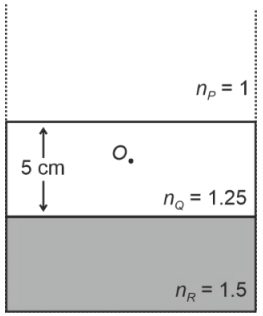
Consider three media $P, Q$ and $R$ with refractive indices $1,1.25$, and 1.5 respectively. The medium $Q$ having a thickness of 5 cm is placed between extended media $P$ and $R$ as shown in the figure. An object $O$ is placed at the centre of medium $Q$. If viewed from medium $P$ near the normal direction, the apparent depth of $O$ is $h_1$. For similar observation from medium $R$, the apparent depth is $h_2$. The value of $\left|h_1-h_2\right|$, in cm , is:
The lens combination as shown in the figure, consists of two lenses, $L_1$ and $L_2$, of the focal lengths +10 cm and -10 cm , respectively. The position of the image formed is:

Which of the following measurements require 'index correction'?

A ray of monochromatic light is passing through an equilateral prism $(A B C)$ as shown in the figure. The refracted ray $(Q R)$ is parallel to its base $(B C)$ and the angle of incidence $(i)$ is $50^{\circ}$. Then the angle of deviation $(\delta)$ is:

NEET Subjects
Browse all chapters by subject