GATE ECE
GROUP-1
(A) Hartley
(B) Wein-bridge
(C) Crystal
GROUP-2
(1) Low frequency oscillator
(2) High frequency oscillator
(3) Stable frequency oscillator
(4) Relaxation oscillator
(5) Nagative Resistance oscillator
List-1
(a) Very low response at very high frequencies.
(b) Overshoot
(c) Synchro-control transformer output
List-2
(1) Low pass systems
(2) Velocity damping
(3) Natural frequency
(4) Phase-sensitive modulation
(5) Damping ration
(a) Over damped
(b) Critically damped
(c) Oscillatory
If the transfer function has
(1) poles on the negative real axis
(2) poles on the imaginary axis
(3) multiple poles on the positive real axis
(4) poles on the positive real axis
(5) multiple poles on the negative real axis
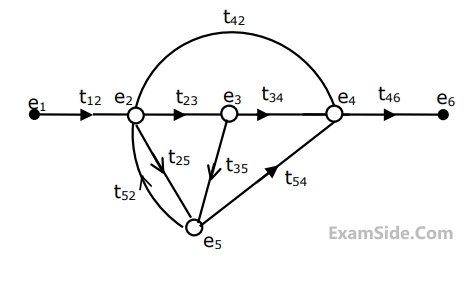
(1) What will be the minimized SOP expression for F?
(2) Implement this function on an 8 : 1 MUX.
List - 1
A. Successive approximation
B. Dual-slope
C. Parallel Comparator
List - 2
1) 1
2) 8
3) 16
4) 256
5) 512
Determine
(1) The axial ratio
(2) The angle between the major axis of the polarization ellipse and the $$+x$$-axis.
$${{x_1} + {x_2} + {x_3} = 3}$$
$${{x_1} - {x_3} = 0}$$
$${{x_1} - {x_2} + {x_3} = 1}$$ has
List-$${\rm I}$$
$$(P)$$ $${a_1}{{{d^2}y} \over {d{x^2}}} + {a_2}y{{dy} \over {dx}} + {a_3}y = {a_4}$$
$$(Q)$$ $${a_1}{{{d^2}y} \over {d{x^3}}} + {a_2}y = {a_3}$$
$$(Q)$$ $${a_1}{{{d^2}y} \over {d{x^2}}} + {a_2}x{{dy} \over {dx}} + {a_3}{x^2}y = 0$$
List-$${\rm II}$$
$$(1)$$ Non-linear differential equation
$$(2)$$ Linear differential equation with constants coefficients
$$(3)$$ Linear homogeneous differential equation
$$(4)$$ Non-linear homogeneous differential equation
$$(5)$$ Non-linear first order differential equation
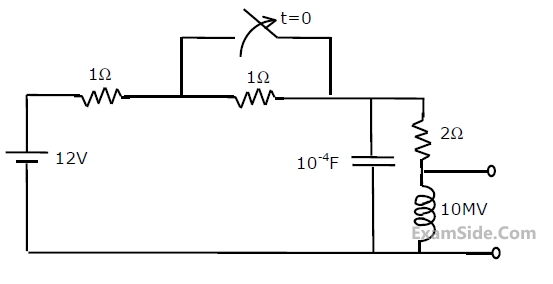
(1) Determine the initial voltage, VC(0-), across the capacitor, and the initial current, iL(0-) , through the indicator.
(2) Calculate the voltage, VL(t) , across the inductance for t > 0.
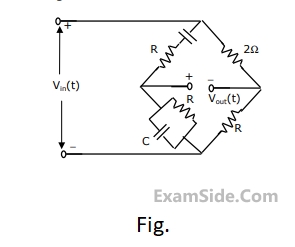
$$T(s) = {{{V_2}\,(s)} \over {{V_1}\,(s)}} = \,{K \over {{s^2} + \,(3 - K)\,s + 1}}$$

A generator of internal impedance, ZG, delivers maximum power to a load impedance, ZL, only if ZL = ................
If G(s) is a stable transfer function, then $$F\left( s \right) = {1 \over {G\left( s \right)}}$$ is always a stable transfer function.
List - 1
(A) $${a_1}{{{d^{2y}}} \over {d{x^2}}} + {a_2}y{{dy} \over {dx}} + {a_3}y = {a_4}$$
(B) $${a_1}{{{d^3}y} \over {d{x^3}}} + {a_2}y = {a_3}$$
(C) $$\eqalign{
& {a_1}{{{d_2}y} \over {d{x_2}}} + {a_2}x{{dy} \over {dx}} + {a_3}\,{x^2}y = 0 \cr
& \cr} $$
List - 2
(1) Non linear differential equation.
(2) Linear differential equation with constant coefficients.
(3) Linear homogeneous differential equation.
(4) Non - Linear homogeneous differential equation.
(5) Non - linear first order differential equation.
Calculate the value of the ratio, $${a \over b}$$, for which 50% of the input signal energy is transferred to the output.
