GATE EE


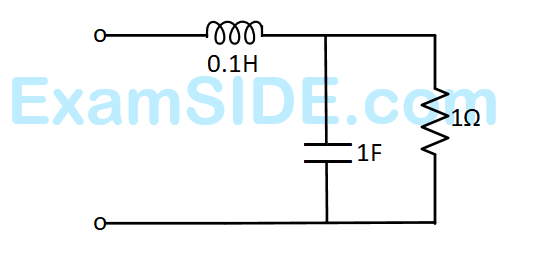
If the above step response is to be observed on a non - storage $$CRO,$$ then it would be best have the $${e_i}$$ as a

For a step input $${e_{i,}}$$ the overshoot in the output $${e_{0,}}$$ will be


can be reduced to the form

With

Such a division can be correctly performed by the following set of operations
Suppose Register contains the $$2's$$ complement number $$11010110.$$ If this number is delivered by $$2$$ the answer should be

$$V = {\left[ {{v_1}\,\,{v_2}....{v_6}} \right]^T}$$ denote the vector of branches voltages while
$${\rm I} = {\left[ {{i_1}\,{i_2}....{i_6}} \right]^T}$$ that of branch currents. The vector $$E = {\left[ {{e_1}\,{e_2}\,\,{e_3}\,{e_4}} \right]^T}$$ denotes the vector of node voltages relative to a common ground. $$$A = \left[ {\matrix{ 1 & 1 & 1 & 0 & 0 & 0 \cr 0 & { - 1} & 0 & { - 1} & 1 & 0 \cr { - 1} & 0 & 0 & 0 & { - 1} & { - 1} \cr 0 & 0 & { - 1} & 1 & 0 & 1 \cr } } \right]$$$
Which of the following statements is true?
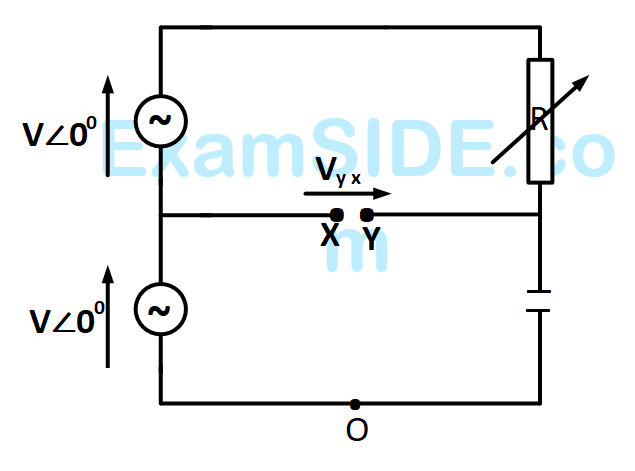
then the magnitude of $$R$$ is


If a starting torque of $$0.5$$ per unit is required then the per unit starting current should be
If a star-delta starter is used to start this induction motor, the per unit staring torque will be
If an auto-transformer is used for reduced voltage starting to provide $$1.5$$ per unit starting torque, the auto-transformer ratio $$\left( \% \right)$$ should be
The average force on the core to reduce the air gap will be
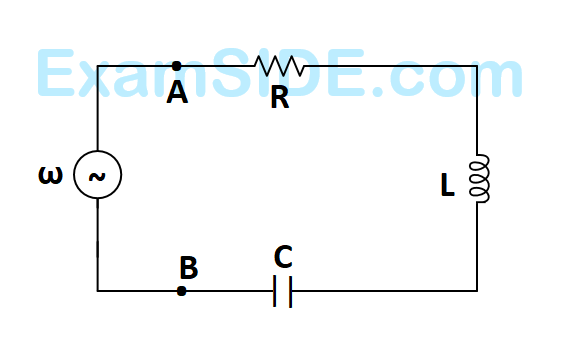
The current in the inductor is
zero vector. The $$n\,\, \times \,\,n$$ matrix $$V = X{X^T}$$

The diode conducts for

$$THD = {{\sqrt {V_{rms}^2 - V_1^2} } \over {{V_1}}} \times 100,\,\,\,$$ Where $${{V_1}}$$ is the $$rms$$ value of the fundamental component of the voltage. The $$THD$$ of output $$ac$$ voltage waveform is
$$T{h_M}$$ is $$ON$$
$$T{h_AUX}$$ is trigged at $$t=0.$$ $$T{h_M}$$ is turned $$OFF$$ between.

The minimum approximate volt $$-$$second rating of the pulse transformer suitable for triggering the $$SCR$$ should be: (Volt - second rating is the maximum of product of the voltage and the width of the pulse that may be applied)
The resistance $$R$$ should be


 b
b$$\left[ {\matrix{ {{f_a}} \cr {{f_b}} \cr {{f_c}} \cr } } \right] = k\left[ {\matrix{ 1 & 1 & 1 \cr {{\alpha ^2}} & \alpha & 1 \cr \alpha & {{\alpha ^2}} & 1 \cr } } \right]\left[ {\matrix{ {{f_p}} \cr {{f_n}} \cr {{f_o}} \cr } } \right]$$ where $$\,\alpha = {e^{j{{2\pi } \over 3}}}\,\,$$ and $$k$$ is a constant
Now, if it is given that:
$$\left[ {\matrix{ {{V_p}} \cr {{V_n}} \cr {{V_o}} \cr } } \right] = k\left[ {\matrix{ {0.5} & 0 & 0 \cr 0 & {0.5} & 0 \cr 0 & 0 & {2.0} \cr } } \right]\left[ {\matrix{ {{i_p}} \cr {{I_n}} \cr {{i_o}} \cr } } \right]\,\,$$ and $$\left[ {\matrix{ {{V_a}} \cr {{V_b}} \cr {{V_c}} \cr } } \right] = z\left[ {\matrix{ {{i_a}} \cr {{I_b}} \cr {{i_c}} \cr } } \right]\,\,$$ then,


Distribution Company's policy requires radial system operation with minimum loss. This can be achieved by opening of the branch

$$x\left( t \right) = \left\{ {\matrix{ {1, - {\raise0.5ex\hbox{$\scriptstyle T$} \kern-0.1em/\kern-0.15em \lower0.25ex\hbox{$\scriptstyle 4$}} < t \le {\raise0.5ex\hbox{$\scriptstyle {3T}$} \kern-0.1em/\kern-0.15em \lower0.25ex\hbox{$\scriptstyle 4$}}} \cr { - 1,{\raise0.5ex\hbox{$\scriptstyle {3T}$} \kern-0.1em/\kern-0.15em \lower0.25ex\hbox{$\scriptstyle 4$}} < t \le {\raise0.5ex\hbox{$\scriptstyle {7T}$} \kern-0.1em/\kern-0.15em \lower0.25ex\hbox{$\scriptstyle 4$}},\,\,\,} \cr { - x\left( {t + T} \right)} \cr } } \right.$$ Which among the following gives the fundamental Fourier term of $$x(t)$$?
$$G\left( z \right) = a{z^{ - 1}} + \beta \,\,{z^{ - 3}}$$ is a low-pass digital filter with a phase characteristic same as that of the above question if
$$g\left( 0 \right) = 0,\,\,g\left( 1 \right) = g\left( 2 \right) = 1,\,g\left( 3 \right) = g\left( 4 \right) = .... = 0$$
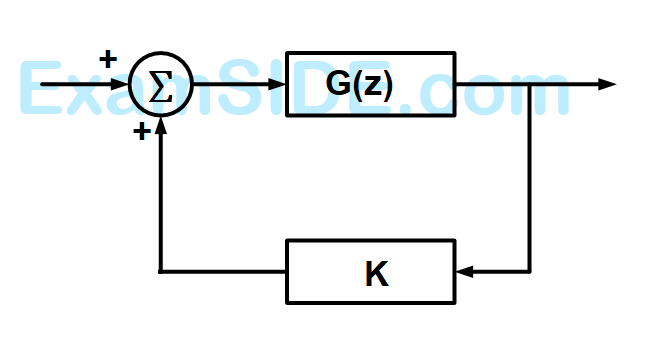
This system is stable for range of values of $$K$$