1
GATE ME 2009
MCQ (Single Correct Answer)
+2
-0.6
Consider steady, incompressible and irrotational flow through a reducer in a horizontal pipe where the diameter is reduced from $$20cm$$ to $$10cm.$$ The pressure in the $$20cm$$ pipe just upstream of the reducer is $$150kPa.$$ The fluid has a vapour pressure of $$50kPa$$ and a specific weight of $$5\,\,kN/{m^3}.$$ Neglecting frictional effects, the maximum discharge (in $${m^3}/s$$) that can pass through the reducer without causing cavitation is
2
GATE ME 2009
MCQ (Single Correct Answer)
+2
-0.6
Consider steady-state heat conduction across the thickness in a plane composite wall as shown in fig exposed to convection conditions on both sides.
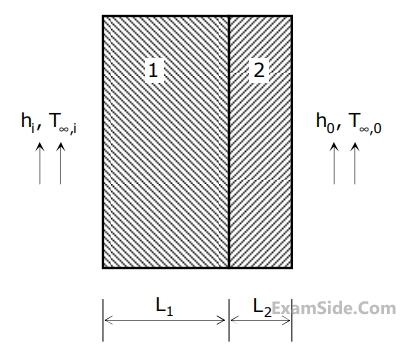
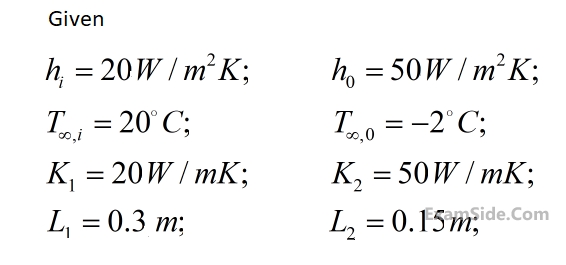
Assuming negligible contact resistance between the wall surfaces, the interface temp $$T(C)$$ of the two walls will be
3
GATE ME 2009
MCQ (Single Correct Answer)
+2
-0.6
Radiative heat transfer is intended between the inner surfaces of two very largen isothermal parallel metal plates. While the upper plate (designated as plate $$1$$) is a black surface and is the warmer one being maintained at $${727^ \circ }C,$$ the lower plate (plate $$2$$) is a diffuse and gray surface with an emissivity of $$0.7$$ and is kept at $${27^ \circ }C.$$ Assume that the surfaces are sufficiently large to form a two-surface enclosure and steady state conditions to exist. Stefan Boltzmann constant is given as
$$5.67 \times {10^{ - 8}}\,W/{m^2}{K^4}$$
$$5.67 \times {10^{ - 8}}\,W/{m^2}{K^4}$$
If plate is also a diffuse gray surface with an emisivity value of $$0.8,$$ the net radiant heat exchange (in $$kW/{m^2}$$) between plate $$1$$ and plate $$2$$
4
GATE ME 2009
MCQ (Single Correct Answer)
+2
-0.6
In a parallel flow heat exchanger operating under steady state, the heat capacity rates (product of specific heat at constant pressure and mass flow rate) of the hot and cold fluid are equal. The hot fluid, flowing at $$1kg/sec$$ with $$sp.$$ heat $$= 4kJ/kgK,$$ enters the heat exchanger at $${102^ \circ }C$$ while the cold fluid has an inlet temperature of $${15^ \circ }C$$. The overall heat transfer coefficient for the heat exchanger is estimated to be $$1\,\,kW/{m^2}K$$ and the corresponding heat transfer surface area is $$5{m^2}$$. Neglect heat transfer between the heat exchanger and the ambient.
The heat exchanger is characterized by the following relation $$2\varepsilon = 1 - Exp\left( { - 2NTU} \right).$$ The exit temp (in $$^ \circ C$$) for the cold fluid is
Paper Analysis
Total Questions
Engineering Mathematics 9
Engineering Mechanics 2
Fluid Mechanics 4
Heat Transfer 5
Industrial Engineering 7
Machine Design 3
Production Engineering 8
Strength of Materials 6
Theory of Machines 6
Thermodynamics 5
More Papers of GATE ME
GATE ME 2025 GATE ME 2024 GATE ME 2023 GATE ME 2022 Set 2 GATE ME 2022 Set 1 GATE ME 2020 Set 2 GATE ME 2020 Set 1 GATE ME 2019 Set 1 GATE ME 2019 Set 2 GATE ME 2018 Set 1 GATE ME 2018 Set 2 GATE ME 2017 Set 1 GATE ME 2017 Set 2 GATE ME 2016 Set 2 GATE ME 2016 Set 3 GATE ME 2016 Set 1 GATE ME 2015 Set 1 GATE ME 2015 Set 2 GATE ME 2015 Set 3 GATE ME 2014 Set 1 GATE ME 2014 Set GATE ME 2014 Set 3 GATE ME 2014 GATE ME 2014 Set 4 GATE ME 2014 Set 2 GATE ME 2013 GATE ME 2012 GATE ME 2011 GATE ME 2010 GATE ME 2009 GATE ME 2008 GATE ME 2007 GATE ME 2006 GATE ME 2005 GATE ME 2004 GATE ME 2003 GATE ME 2002 GATE ME 2001 GATE ME 2000 GATE ME 1999 GATE ME 1998 GATE ME 1997 GATE ME 1996 GATE ME 1995 GATE ME 1994 GATE ME 1993 GATE ME 1992 GATE ME 1991 GATE ME 1990 GATE ME 1989 GATE ME 1988 GATE ME 1987
GATE ME Papers
All year-wise previous year question papers
2025
2024
2023
2014
2013
2012
2011
2010
2009
2008
2007
2006
2005
2004
2003
2002
2001
2000
1999
1998
1997
1996
1995
1994
1993
1992
1991
1990
1989
1988
1987