1
GATE EE 2017 Set 2
MCQ (Single Correct Answer)
+1
-0.3
The figure show the per-phase representation of a phase-shifting transformer connected between buses $$1$$ and $$2,$$ where $$\alpha $$ is a complex number with non-zero real and imaginary parts.
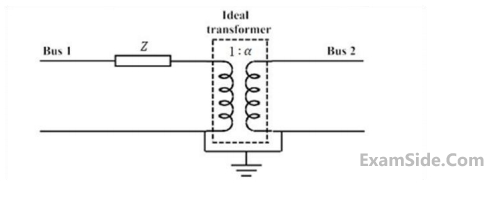
For the given circuit, $${Y_{bus}}$$ and $${Z_{bus}}$$ are bus admittance matrix and bus impedance matrix, respectively, each of size $$2\, \times \,2$$. Which one of the following statements is true?
For the given circuit, $${Y_{bus}}$$ and $${Z_{bus}}$$ are bus admittance matrix and bus impedance matrix, respectively, each of size $$2\, \times \,2$$. Which one of the following statements is true?
2
GATE EE 2017 Set 2
Numerical
+2
-0
Consider an overhead transmission line with $$3$$-phase, $$50$$ $$Hz$$ balanced system with conductors located at the vertices of an equilateral triangle of length $$\,{D_{ab}} = {D_{bc}} = {D_{ca}} = 1\,\,\,$$ m as shown in figure below. The resistance of the conductors are neglected. The geometric mean radius (GMR) of each conductor is $$0.01$$ $$m$$. Neglect the effect of ground, the magnitude of positive sequence reactance in $$\,\Omega $$/$$km$$ (rounded off to three decimal places) is ________________.

Your input ____
3
GATE EE 2017 Set 2
Numerical
+1
-0
The normal - $$\pi $$ circuit of a transmission line is shown in the figure.
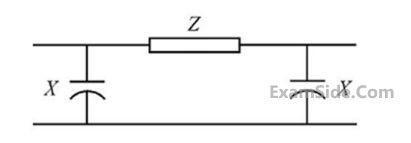
Impedance $$Z = 100\angle {80^ \circ }$$ and reactance $$\,X = 3300\Omega .$$ The magnitude of the characteristic impedance of the transmission line, in $$\Omega ,$$ is ________. (Give the answer up to one decimal place.)
Your input ____
4
GATE EE 2017 Set 2
MCQ (Single Correct Answer)
+2
-0.6
A cascade system having the impulse responses $$$\begin{array}{l}h_1\left(n\right)=\left\{1,\;-1\right\}\;\;\;and\;\;h_2\left(n\right)=\left\{1,\;1\right\}\\\;\;\;\;\;\;\;\;\;\;\;\;\;\;\;\;\uparrow\;\;\;\;\;\;\;\;\;\;\;\;\;\;\;\;\;\;\;\;\;\;\;\;\;\;\;\;\;\;\;\;\;\;\;\;\uparrow\end{array}$$$ is shown in the
figure below, where symbol $$\uparrow$$ denotes the time origin.
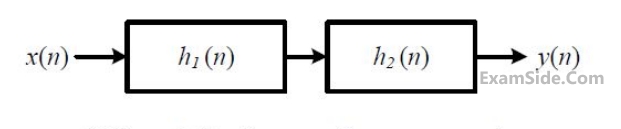 The input sequence x(n) for which the cascade system produces an output sequence
$$$\begin{array}{l}y\left(n\right)=\left\{1,\;2,\;1,\;-1,\;-2,\;-1\right\}\;\;is\\\;\;\;\;\;\;\;\;\;\;\;\;\;\;\;\uparrow\end{array}$$$
The input sequence x(n) for which the cascade system produces an output sequence
$$$\begin{array}{l}y\left(n\right)=\left\{1,\;2,\;1,\;-1,\;-2,\;-1\right\}\;\;is\\\;\;\;\;\;\;\;\;\;\;\;\;\;\;\;\uparrow\end{array}$$$
The input sequence x(n) for which the cascade system produces an output sequence
$$$\begin{array}{l}y\left(n\right)=\left\{1,\;2,\;1,\;-1,\;-2,\;-1\right\}\;\;is\\\;\;\;\;\;\;\;\;\;\;\;\;\;\;\;\uparrow\end{array}$$$
Paper Analysis
Total Questions
Analog Electronics 2
Control Systems 5
Digital Electronics 2
Electric Circuits 6
Electrical and Electronics Measurement 3
Electrical Machines 9
Electromagnetic Fields 3
Engineering Mathematics 9
Power Electronics 6
Power System Analysis 6
Signals and Systems 3
More Papers of GATE EE
GATE EE 2026 GATE EE 2025 GATE EE 2024 GATE EE 2023 GATE EE 2022 GATE EE 2021 GATE EE 2020 GATE EE 2019 GATE EE 2018 GATE EE 2017 Set 1 GATE EE 2017 Set 2 GATE EE 2016 Set 2 GATE EE 2016 Set 1 GATE EE 2015 Set 1 GATE EE 2015 Set 2 GATE EE 2014 Set 2 GATE EE 2014 Set 3 GATE EE 2014 Set 1 GATE EE 2013 GATE EE 2012 GATE EE 2011 GATE EE 2010 GATE EE 2009 GATE EE 2008 GATE EE 2007 GATE EE 2006 GATE EE 2005 GATE EE 2004 GATE EE 2003 GATE EE 2002 GATE EE 2001 GATE EE 2000 GATE EE 1999 GATE EE 1998 GATE EE 1997 GATE EE 1996 GATE EE 1995 GATE EE 1994 GATE EE 1993 GATE EE 1992 GATE EE 1991
GATE EE Papers
All year-wise previous year question papers
2026
2025
2024
2023
2022
2021
2020
2019
2018
2013
2012
2011
2010
2009
2008
2007
2006
2005
2004
2003
2002
2001
2000
1999
1998
1997
1996
1995
1994
1993
1992
1991