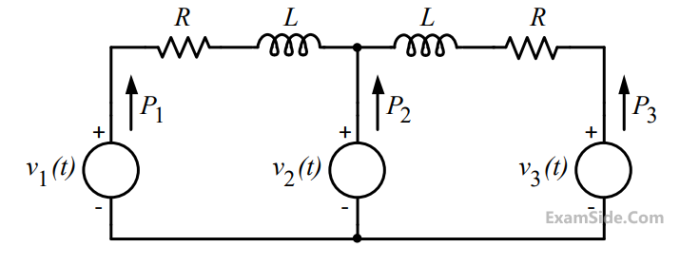
The positive, negative and zero sequence impedances of a three phase generator are Z1, Z2
and Z0 respectively. For a line-to-line fault with fault impedance Zf, the fault current
is If1 = kIf, where If is the fault current with zero fault impedance. The relation between
Zf and k is
$${v_1}\left( t \right) = 100\cos \left( {\omega t} \right)$$
$${v_2}\left( t \right) = 100\cos \left( {\omega t + {\pi \over {18}}} \right)$$
and $${v_3}\left( t \right) = 100\cos \left( {\omega t + {\pi \over {36}}} \right)$$.
The circuit is in sinusoidal steady state, and R << $${\omega L}$$.
P1, P2 and P3 are the average power outputs. Which one of the following statements is true?
A
P1 = P2 = P3 = 0
B
P1 < 0, P2 > 0, P3 > 0
C
P1 < 0, P2 > 0, P3 < 0
D
P1 > 0, P2 < 0, P3 > 0
3
GATE EE 2018
MCQ (Single Correct Answer)
+2
-0.67
The per-unit power output of a salient-pole generator which is connected to an infinite bus,
is given by the expression, P = 1.4 sin $$\delta $$ + 0.15 sin 2$$\delta $$, where $$\delta $$ is the load angle. Newton-Raphson method is used to calculate the value of $$\delta $$ for P = 0.8 pu. If the initial guess is
$$30^\circ $$, then its value (in degree) at the end of the first iteration is
A
$$15^\circ $$
B
$$28.48^\circ $$
C
$$31.20^\circ $$
D
$$28.74^\circ $$
4
GATE EE 2018
Numerical
+1
-0
The series impedance matrix of a short three-phase transmission line in phase coordinates is
$$\left[ {\matrix{
{{Z_s}} & {{Z_m}} & {{Z_m}} \cr
{{Z_m}} & {{Z_s}} & {{Z_m}} \cr
{{Z_m}} & {{Z_m}} & {{Z_s}} \cr
} } \right]$$.
If the positive sequence impedance is (1 + 𝑗 10) $$\Omega $$, and the zero
sequence is (4 + 𝑗 31) $$\Omega $$, then the imaginary part of Zm (in $$\Omega $$) is ______(up to 2 decimal
places).