Combinatorics deals with problems involving counting. For example, "How many distinct arrangements of N distinct objects in M spaces on a circle are possible?" is a typical problem in combinatorics. This kind of counting is sometimes used in the modeling of several physical phenomena. Often, in such models, the different combinatorial possibilities are assigned probability values. Assigning probabilities enables the computation of the average values of physical quantities.
Consider the following statements:
P : Combinatorics is always invoked in the modeling of physical phenomena.
Q : Modeling some physical phenomena involves assigning probabilities to combinatorial possibilities in order to compute average values of physical quantities.
Based on the passage above, what can be inferred about statements $P$ and $Q$ ?
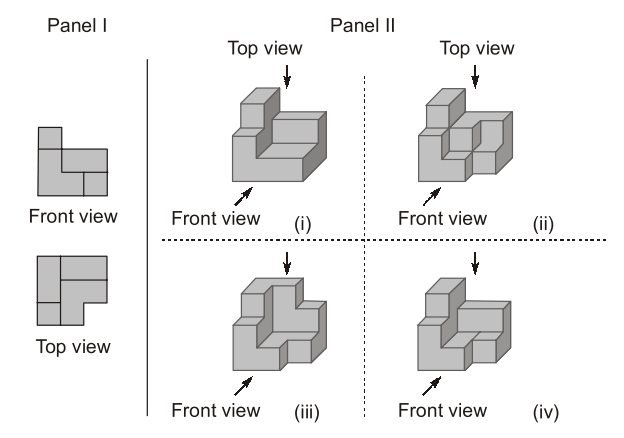
In Panel I of the figure below, the front view and top view of a structure are shown. Which one of the 3D structures shown in Panel II possesses the views shown in Panel I?
For positive real numbers $S$ and $K$, the function $H_K(S)$ is defined as: $H_K(S)=\max (S-K, 0)$. The max function is defined as:
$$ \max (a, b)= \begin{cases}a, & \text { when } a>b \\ b, & \text { when } a \leq b\end{cases} $$
The graph below shows the plot of a function $N(S)$ versus $S$. $N(S)$ can be expressed as $\_\_\_\_$ .

In the 2020 summer Olympics' Javelin throw finals, Neeraj Chopra exhibited a spectacular performance to win the gold medal. The silver medal was won by Jakub Vadlejch and the bronze medal was won by Vitezlav Vesely. There were six rounds of throws with each athlete having one throw per round. The best of all the throws of each athlete is considered for the medal. Following were the observations about the throws:
(i) The first and second rounds were dominated by Neeraj Chopra with a gold medal performance in his second throw, while the other two athletes did not have any medal winning throws in these rounds.
(ii) The throws in the last round by both Jakub Vadlejch and Vitezlav Vesely were fouls and were not considered for scoring.
(iii) After four rounds, Vitezlav Vesely was in the second position and could not improve upon his best throw in the succeeding rounds.
(iv) In the fourth round, the throw by Jakub Vadlejch was the best in that round. In which round did Vitezlav Vesely have his best throw?
GATE CSE Papers
All year-wise previous year question papers