Aldehyde and Ketone · Chemistry · AP EAPCET
MCQ (Single Correct Answer)
What is ' $Z$ ' in the following reaction sequence?
$$ \mathrm{C}_3 \mathrm{H}_6 \xrightarrow[\mathrm{CCl}_4]{\mathrm{Br}_2} \underset{\text { (Colourless) }}{X} \xrightarrow[\text { (ii) } \mathrm{NaNH}_2, \Delta]{\text { (i) } \mathrm{KOH} / \text { Alcohol }} Y\xrightarrow[\substack{\mathrm{Hg}^{2+}, \mathrm{H}^{+} \\ 333 \mathrm{~K}}]{\mathrm{H}_2 \mathrm{O}} Z$$
What are $X$ and $Y$ respectively in the following reaction sequence?

What are $X$ and $Y$ respectively in the following sets of reactions?

A carbonyl compound $X\left(\mathrm{C}_8 \mathrm{H}_8 \mathrm{O}\right)$ undergoes disproportionation with conc. KOH on heating. Product of $X$ with $\mathrm{Zn}-\mathrm{Hg} / \mathrm{HCl}$ is $Y$ and product of $X$ with $\mathrm{NaBH}_4$ is Z . What are $Y$ and Z respectively?
What is the major product $Y$ in the following reaction sequence?

Arrange the following in decreasing order of electrophilicity of carbonyl carbon.


$$ \mathrm{CH}_3 \mathrm{CH}_2 \mathrm{CHO} $$
The structure of the product ' $Z$ ' in the reaction sequence is

In the given reaction sequence, conversion of $X$ to $Y$ is an example of

$$ \text { Match the following } $$


The correct answer is
Consider the reaction sequence
$$ \text { Dimethyl ketone } \xrightarrow[\text { (ii) } \mathrm{H}_2 \mathrm{O}]{\text { (i) } \mathrm{CH}_3 \mathrm{MgCl}} X \xrightarrow[\text { (ii) } \mathrm{CH}_3 \mathrm{Br}]{\text { (i) } \mathrm{Na}} Y $$
How many $s p^3$ carbons are present in $Y$ ?
Which of the following represents Etard reaction?
The correct statement about the product of the following reaction is
$$ \mathrm{CH}_3 \mathrm{CHO} \xrightarrow[\text { (ii) } \mathrm{H}_2 \mathrm{O}]{\text { (i) } \mathrm{C}_2 \mathrm{H}_5 \mathrm{MgBr}} \text { product } $$
A carbonyl compound $X\left(\mathrm{C}_8 \mathrm{H}_8 \mathrm{O}\right)$ gives yellow precipitate with NaOI .
Hemiacetal of $X$ with methanol/dry HCl is

Which of the following sets of reagents convert toluene to benzaldehyde?
A. $\mathrm{Cl}_2 \mid h v ; \mathrm{H}_2 \mathrm{O}, \Delta$
B. $\mathrm{KMnO}_4 \mid \mathrm{OH}^{-} ; \mathrm{H}^{+}$
C. $\mathrm{Cl}_2 \mid \mathrm{Fe} ; \mathrm{H}_2 \mathrm{O}$
D. $\mathrm{CrO}_2 \mathrm{Cl}_{21} \mid \mathrm{CS}_2 ; \mathrm{H}_3 \mathrm{O}^{+}$
Match the following reagents with the products obtained when they reacted with a ketone.
| List I | List II | ||
|---|---|---|---|
| A. | $$ \mathrm{C}_6 \mathrm{H}_5 \mathrm{NHNH}_2 $$ |
i. | Schiff base |
| B. | $$ \mathrm{NH}_2 \mathrm{OH} $$ |
ii. | Hydrazone |
| C. | $$ \mathrm{C}_6 \mathrm{H}_5 \mathrm{NH}_2 $$ |
iii. | Oxime |
| iv. | Phenyl hydrazone | ||
$$ \text { Correct answer is } $$
$$ \text { Consider the reactions, } $$
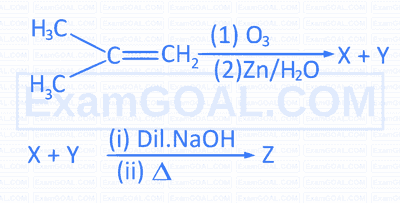
$$ \text { The incorrect statement about ' } B \text { ' is } $$
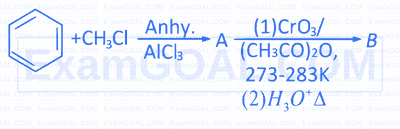
$$ \text { The incorrect statement about } B \text { is } $$
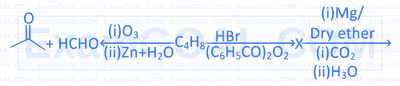

Identify the major product from the following reaction sequence.

Identify the major product formed in the following reaction sequence

Arrange the following in increasing order of their reactivity for nucleophilic addition reaction.
(A) 
(B) 
(C) 
(D) 
Identify (Z) in the following reaction.
$$\mathrm{C{H_3}COOH\buildrel {LiAl{H_4}} \over \longrightarrow (X)\mathrel{\mathop{\kern0pt\longrightarrow} \limits_{573\,K}^{Cu}} (Y)\buildrel {dil.\,NaOH} \over \longrightarrow (Z)}$$
The total number of products formed in the following reaction sequence is
$$\begin{gathered}\mathrm{CH}_3 \mathrm{COCl} \stackrel{\text { (i) }\left(\mathrm{CH}_3\right)_3 \mathrm{Cd}}{\longrightarrow}(P) \\ (P)+\mathrm{CH}_3 \mathrm{CHO} \stackrel{\text { (ii) } \mathrm{NaOH}(a q), \Delta}{\longrightarrow} \text { ? }\end{gathered}$$