Alcohol, Phenols and Ethers · Chemistry · AP EAPCET
MCQ (Single Correct Answer)
An alcohol $X\left(\mathrm{C}_5 \mathrm{H}_{12} \mathrm{O}\right)$ on dehydration gives $Y$ (major product). Reaction of $Y$ with HBr gave $Z\left(\mathrm{C}_5 \mathrm{H}_{11} \mathrm{Br}\right)$, major product). $Z$ undergoes nucleophilic substitution in two steps. What are $X$ and $Y$ ?
An alcohol, $X\left(\mathrm{C}_5 \mathrm{H}_{12} \mathrm{O}\right)$ in the presence of $\mathrm{Cu} / 573 \mathrm{~K}$ gives $Y\left(\mathrm{C}_5 \mathrm{H}_{10}\right)$. The reactants required for the preparation of $X$ are
What are $X$ and $Y$ respectively in the following set of reactions?

$$ \text { Match the following } $$
$$ \begin{array}{llll} \hline & \text { List-I (Compound) } & & \text { List-II }\left(\mathrm{pK}_{\mathrm{a}}\right) \\ \hline \text { (A) } & \text { p-nitrophenol } & \text { (I) } & 15.9 \\ \hline \text { (B) } & \text { Phenol } & \text { (II) } & 7.1 \\ \hline \text { (C) } & \text { Ethanol } & \text { (IIII) } & 10.0 \\ \hline \text { (D) } & \text { p-cresol } & \text { (IV) } & 10.2 \\ \hline & & \text { (N) } & 8.3 \\ \hline \end{array} $$
The correct answer is
An alcohol $X\left(\mathrm{C}_4 \mathrm{H}_{10} \mathrm{O}\right)$ on dehydration gave alkene $\left(\mathrm{C}_4 \mathrm{H}_8\right)$ as major product, which on bromination followed by treatment with $Y$ gave alkyne $\mathrm{C}_4 \mathrm{H}_6$. Alkyne $\mathrm{C}_4 \mathrm{H}_6$, does not react with sodium metal. What are $X$ and $Y$ ?
The correct statement regarding $X$ and $Y$ formed in the following reaction is
$$ \left(\mathrm{CH}_3\right)_3 \mathrm{COC}_2 \mathrm{H}_5 \xrightarrow[\Delta]{\mathrm{HI}} \text { halide }(X)+\text { alcohol }(Y) $$
The correct order of boiling points of the compounds given below is
(A) methoxy ethane
(B) propan-1-ol
(C) propanal
(D) propanone
The number of primary $\left(1^{\circ}\right)$, secondary $\left(2^{\circ}\right)$ and tertiary $\left(3^{\circ}\right)$ alcohols possible for the formula $\mathrm{C}_5 \mathrm{H}_{12} \mathrm{O}$ respectively are
In which of the following intramolecular H -bonding is absent?


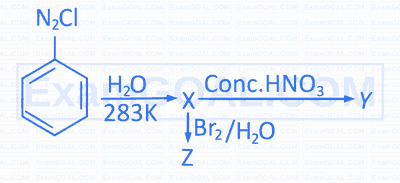 $Y$ and $Z$ respectively are
Identify the product(s) formed in the following reaction.

Which compound is formed on catalytic hydrogenation of carbon monoxide at high $$p$$ and high $$T$$ in presence of $$\mathrm{ZnO}-\mathrm{Cr}_2 \mathrm{O}_3$$ catalyst?
The correct order of acidity of the following compounds is

Identify the best suitable reagent for the following reaction.

In the following reaction sequence, identify product ‘Q’ and reagent ‘R’.
