A simple pendulum has mass 2 gram and charge $2 \mu \mathrm{C}$. In a uniform horizontal electric field of intensity $1000 \mathrm{~V} / \mathrm{m}$, pendulum is at rest. At equilibrium, the angle made by the pendulum with the vertical is ( $\mathrm{g}=$ acceleration due to gravity $=10 \mathrm{~m} / \mathrm{s}^2$ )
The charges are arranged at the four corners of square $A B C D$ of side ' $d$ ' as shown in figure. The work required to put this arrangement together is given by

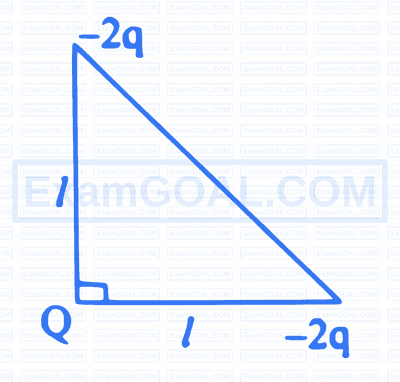
Three charges $Q,-2 q$ and $-2 q$ are placed at the vertices of an isosceles right-angled triangle as shown in figure. The net electrostatic potential energy is zero if $Q$ is equal to
A large insulated sphere of radius ' $r$ ', charged with ' $Q$ ' units of electricity, is placed in contact with a small insulated uncharged sphere of radius ' R ' and is then separated. The charge on the smaller sphere will now be
MHT CET (Biology) Subjects
Browse all chapters by subject