A thin lens is a transparent optical medium bounded by two surfaces, at least one of which should be spherical. Applying the formula for image formation by a single spherical surface successively at the two surfaces of a lens, one can obtain the 'lens maker formula' and then the 'lens formula'. A lens has two foci - called 'first focal point' and 'second focal point' of the lens, one on each side.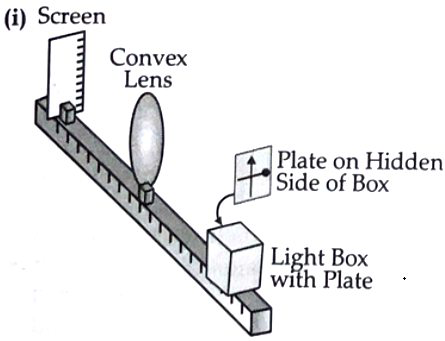 Consider the arrangement shown in figure. A black vertical arrow and a horizontal thick line with a ball are painted on a glass plate. It serves as the object. When the plate is illuminated, its real image is formed on the screen.
Which of the following correctly represents the image formed on the screen.
 (ii) Which of the following statements is incorrect.
(A) For a convex mirror magnification is always negative.
(B) For all virtual images formed by a mirror magnification is positive.
(C) For a concave lens magnification is always positive.
(D) For real and inverted images, magnification is always negative.
(iii) A convex lens of focal length ' $f$ ' is cut into two equal parts perpendicular to the principal axis. The focal length of each part will be
(A) $f$
(B) $2 f$
(C) $\frac{f}{2}$
(D) $\frac{f}{4}$
OR
(iii) If an object in case (i) above is 20 cm from the lens and the screen is 50 cm away from the object, the focal length of the lens used is
(A) 10 cm
(B) 12 cm
(C) 16 cm
(D) 20 cm
(iv) The distance of an object from first focal point of a biconvex lens is $X_1$ and distance of the image from second focal point is $X_2$. The focal length of the lens is
(A) $X_1 X_2$
(B) $\sqrt{X_1+X_2}$
(C) $\sqrt{X_1 X_2}$
(D) $\sqrt{\frac{X_2}{X_1}}$
(a) (i) Two point charges $5 \mu \mathrm{C}$ and $-1 \mu \mathrm{C}$ are placed at points ( $-3 \mathrm{~cm}, 0,0$ ) and ( $3 \mathrm{~cm}, 0,0$ ) respectively. An external electric field $\vec{E}=\frac{A}{r^2} \hat{r}$
where $A=3 \times 10^5 \mathrm{Vm}$ is switched on in the region.
Calculate the change in electrostatic energy of the system due to the electric field.
(ii) A system of two conductors is placed in air and they have net charge of $+80 \mu \mathrm{C}$ and $-80 \mu \mathrm{C}$ which causes a potential difference of 16 V between them.
(1) Find the capacitance of the system.
(2) If the air between the capacitor is replaced by a dielectric medium of dielectric constant 3, what will be the potential difference between the two conductors?
(3) If the charges on two conductors are changed to $+160 \mu \mathrm{C}$ and $-160 \mu \mathrm{C}$, will the capacitance of the system change?
Give reason for your answer.
OR
(b) (i) Consider three metal spherical shells $A, B$ and $C$, each of radius $R$. Each shell is having a concentric metal ball of radius $R / 10$. The spherical shells $\mathrm{A}, B$ and $C$ are given charges $+6 q,-4 q$ and $14 q$ respectively. Their inner metal balls are also given charges $-2 q$, $+8 q$ and $-10 q$ respectively. Compare the magnitude of the electric fields due to shells $A, B$ and $C$ at a distance $3 R$ from their centres.
(ii) A charge $-6 \mu \mathrm{C}$ is placed at the centre $B$ of a semicircle of radius 5 cm , as shown in the figure. An equal and opposite charge is placed at point D at a distance of 10 cm from B. A charge $+5 \mu \mathrm{C}$ is moved from point ' $C$ ' to point ' $A$ ' along the circumference. Calculate the work done on the charge.

(a) (i) A proton moving with velocity $\vec{V}$ in a non. uniform magnetic field traces a path as shown in the figure.
 The path followed by the proton is always in the plane of the paper. What is the direction of the magnetic field in the region near points $P, Q$ and $R$ ? What can you say about relative magnitude of magnetic fields at these points?
(ii) A current carrying circular loop of area $A$ produces a magnetic field $B$ at its centre. Show that the magnetic moment of the loop is $\frac{2 B A}{\mu_0} \sqrt{\frac{A}{\pi}}$
OR
(b) (i) Derive an expression for the torque acting on a rectangular current loop suspended in a uniform magnetic field.
(ii) A charged particle is moving in a circular path with velocity $\vec{V}$ in a uniform magnetic field $\vec{B}$. It is made to pass through a sheet of lead and as a consequence, it looses one half of its kinetic energy without change in its direction. How will (1) the radius of its path (2) its time period of revolution change?
(a) (i) (1) What are coherent sources? Why are they necessary for observing a sustained interference pattern?
(2) Lights from two independent sources are not coherent. Explain.
(ii) Two slits 0.1 mm apart are arranged 1.20 m from a screen. Light of wavelength 600 nm from a distant source is incident on the slits.
(1) How far apart will adjacent bright interference fringes be on the screen?
(2) Find the angular width (in degree) of the first bright fringe.
OR
(b) (i) Define a wave front. An incident plane wave falls on a convex lens and gets refracted through it. Draw a diagram to show the incident and refracted wave front.
(ii) A beam of light coming from a distant source is refracted by a spherical glass ball (refractive index 1.5) of radius 15 cm . Draw the ray diagram and obtain the position of the final image formed.
Class 12 Papers
All year-wise previous year question papers