(a) Define 'Mass defect' and 'Binding energy' of a nucleus. Describe 'Fission process' on the basis of binding energy per nucleon.
(b) A deuteron contains a proton and a neutron and has a mass of 2.013553 u . Calculate the mass defect for it in $u$ and its energy equivalence in MeV . ( $m_p=1.007277$ u, $m_n=1.008665$ u, $\left.1 \mathrm{u}=931.5 \mathrm{MeV} / \mathrm{c}^2\right)$
(a) Draw circuit arrangement for studying $V-I$ characteristics of a $p-n$ junction diode.
(b) Show the shape of the characteristics of a diode.
(c) Mention two information that you can get from these characteristics.
A circuit consisting of a capacitor $C$, a resistor of resistance $R$ and an ideal battery of emf $V$, as shown in figure is known as $R C$ series circuit.

As soon as the circuit is completed by closing key $S_1$ (keeping $S_2$ open) charges begin to flow between the
capacitor plates and the battery terminals. The charge on the capacitor increases and consequently the potential difference $V_c(=q / C)$ across the capacitor also increases with time. When this potential difference equals the potential difference across the battery, the capacitor is fully charged $(Q=V C)$. During this process of charging, the charge $q$ on the capacitor changes with time $t$ as $q=Q \left[1-e^{-t / R C}\right]$
The charging current can be obtained by differentiating it and using $\frac{d}{d x}\left(e^{m x}\right)=m e^{m x}$
Consider the case when $R=20 \mathrm{k} \Omega, C=500 \mu \mathrm{~F}$ and $V=10$ V.
(i) The final charge on the capacitor, when key $S_1$ is closed and $S_2$ is open, is
(A) $5 \mu \mathrm{C}$
(B) 5 mC
(C) 25 mC
(D) 0.1 C
(ii) For sufficient time the key $S_1$ is closed and $S_2$ is open. Now key $S_2$ is closed and $S_1$ is open. What is the final charge on the capacitor?
(A) Zero
(B) 5 mC
(C) 2.5 mC
(D) $5 \mu \mathrm{C}$
(iii) The dimensional formula for $R C$ is
(A) $\left[M L^2 T^{-3} A^{-2}\right]$
(B) $\left[M^0 L^0 T^{-1} A^0\right]$
(C) $\left[M^{-1} L^{-2} T^4 A^2\right]$
(D) $\left[M^0 L^0 T A^0\right]$
(iv) The key $S_1$ is closed and $S_2$ is open. The value of current in the resistor after 5 seconds, is
(A) $\frac{1}{2 \sqrt{e}} \mathrm{~mA}$
(B) $\sqrt{e} \mathrm{~mA}$
(C) $\frac{1}{\sqrt{e}} \mathrm{~mA}$
(D) $\frac{1}{2 e} \mathrm{~mA}$
A thin lens is a transparent optical medium bounded by two surfaces, at least one of which should be spherical. Applying the formula for image formation by a single spherical surface successively at the two surfaces of a lens, one can obtain the 'lens maker formula' and then the 'lens formula'. A lens has two foci - called 'first focal point' and 'second focal point' of the lens, one on each side.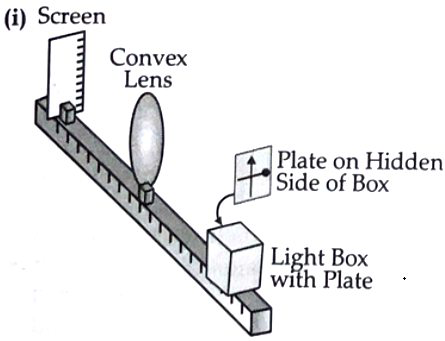 Consider the arrangement shown in figure. A black vertical arrow and a horizontal thick line with a ball are painted on a glass plate. It serves as the object. When the plate is illuminated, its real image is formed on the screen.
Which of the following correctly represents the image formed on the screen.
 (ii) Which of the following statements is incorrect.
(A) For a convex mirror magnification is always negative.
(B) For all virtual images formed by a mirror magnification is positive.
(C) For a concave lens magnification is always positive.
(D) For real and inverted images, magnification is always negative.
(iii) A convex lens of focal length ' $f$ ' is cut into two equal parts perpendicular to the principal axis. The focal length of each part will be
(A) $f$
(B) $2 f$
(C) $\frac{f}{2}$
(D) $\frac{f}{4}$
OR
(iii) If an object in case (i) above is 20 cm from the lens and the screen is 50 cm away from the object, the focal length of the lens used is
(A) 10 cm
(B) 12 cm
(C) 16 cm
(D) 20 cm
(iv) The distance of an object from first focal point of a biconvex lens is $X_1$ and distance of the image from second focal point is $X_2$. The focal length of the lens is
(A) $X_1 X_2$
(B) $\sqrt{X_1+X_2}$
(C) $\sqrt{X_1 X_2}$
(D) $\sqrt{\frac{X_2}{X_1}}$
Class 12 Papers
All year-wise previous year question papers