Consider an equilateral prism of refractive index 1.5 and a parallelepiped block of refractive index 2.0 arranged as shown in the figure such that their adjacent faces are parallel. A light ray enters the prism from air at an angle of incidence such that the ray travels through the prism parallel to its base. What is the angle of emergence $\theta$ ?

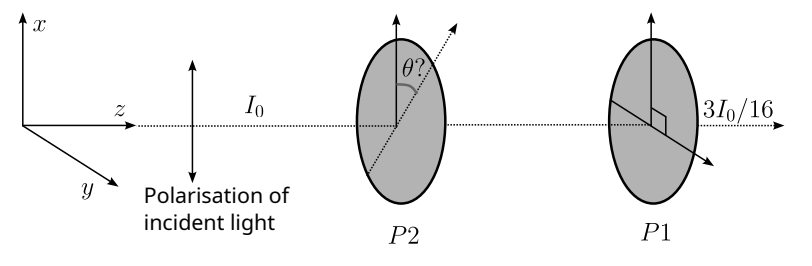
A source produces a light beam of intensity $I_0$ polarized along the $x$-direction. The beam is sent along the $z$-direction. It enters a polaroid $P 1$ with its polaroid axis aligned along the $y$-direction so that no light exits the polaroid. When another polaroid $P 2$ is placed in between the source and $P 1$, the intensity measured after $P 1$ is $3 I_0 / 16$. Which among the following is a possible value of $\theta$, the angle of the polaroid axis measured from the $x$-axis?
An electron in the ground state (with energy $E_1$ ) of a hydrogen atom, absorbs a photon of energy $E_a$, and gets excited to a higher energy level of principal quantum number $n$. What is the value of $n$ ?
A particle of mass $m$ and charge $q$ is accelerated through a distance $d_1$ by an electric field $\vec{E}$. Another particle of mass $M$ and charge $q$ is accelerated by the same electric field through a distance $d_2$. Both the particles emerge with the same de Broglie wavelength $\lambda_B$. What is the ratio of the distances $d_2 / d_1$ ?
IAT (IISER) Papers
All year-wise previous year question papers