A charged particle is moving in a circular orbit with radius $r$ and orbital angular frequency $\omega$ in the presence of a magnetic field. The orbit is enclosed within a larger circular metallic frame. The frame is concentric and coplanar with the orbit. The radius of the frame is now gradually decreased. Assuming that the particle remains within the frame at all times, what changes to the trajectory of the particle will occur as the frame is being shrunk?
Consider an equilateral prism of refractive index 1.5 and a parallelepiped block of refractive index 2.0 arranged as shown in the figure such that their adjacent faces are parallel. A light ray enters the prism from air at an angle of incidence such that the ray travels through the prism parallel to its base. What is the angle of emergence $\theta$ ?

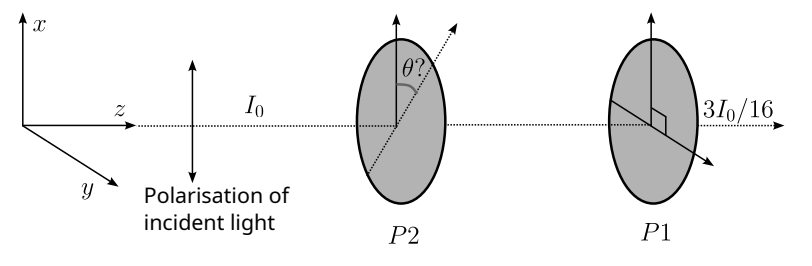
A source produces a light beam of intensity $I_0$ polarized along the $x$-direction. The beam is sent along the $z$-direction. It enters a polaroid $P 1$ with its polaroid axis aligned along the $y$-direction so that no light exits the polaroid. When another polaroid $P 2$ is placed in between the source and $P 1$, the intensity measured after $P 1$ is $3 I_0 / 16$. Which among the following is a possible value of $\theta$, the angle of the polaroid axis measured from the $x$-axis?
An electron in the ground state (with energy $E_1$ ) of a hydrogen atom, absorbs a photon of energy $E_a$, and gets excited to a higher energy level of principal quantum number $n$. What is the value of $n$ ?
IAT (IISER) Papers
All year-wise previous year question papers